When It Happened One Night (1934) was released, both director Frank Capra and screenwriter Robert Riskin were ascending in Hollywood but had not yet reached their peak.
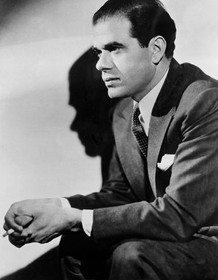
Capra had been directing for Columbia Pictures throughout the late 1920s—He directed two Harry Langdon comedies--and in the early 1930s, fast moving talkies like Manhattan Madness (1930), Ladies of Leisure (1932) and Lady for a Day (1933), helping elevate the studio from a Poverty Row outfit to a major player.

It Happened One Night, based on a short story called "Night Bus" by Samuel Hopkins Adams, faced a difficult start, with actor after actor rejecting the lead roles. Eventually Claudette Colbert took on the role of Ellie and Clark Gable was loaned from MGM to play Peter. Despite the initial reaction--it opened to only so-so reviews, the film performed well in smaller towns and ended up winning every Oscar for which it was nominated, including Best Picture, Best Actor, Best Actress, Best Director, and Best Writing (Adaptation), marking the first time in history that one film swept the top five Oscar categories.
"It’s the story of a salty, hooch-swilling reporter (Clark Gable) who is thrown together with a spoiled society heiress (Claudette Colbert) on an overnight Greyhound bus to New York. The film simply follows them as they bicker, backbite and clamor for the upper hand. Every line of dialogue is calculated bliss, the chemistry between the leads is magnificent, and the backdrop of Depression-era America allows for a prescient and amusing subplot about how well-heeled urbanites are compelled to misbehave when they have no money in their designer pockets. It’s probably more historically important than it is a masterpiece (the last 20 minutes take the missed connections and misunderstandings an inch too far), but it’s still very easy to fall in love with.." - David Jenkins, Time Out
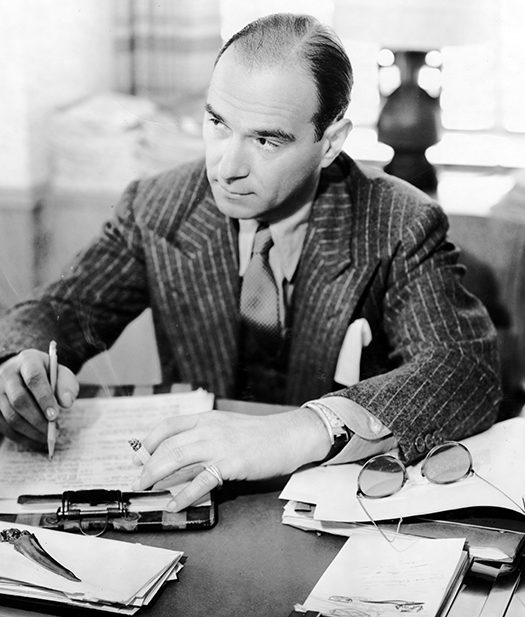
Robert Riskin, a skilled playwright-turned-screenwriter, had been working in Hollywood since the late 1920s. His partnership with Capra resulted in some of the era’s most memorable films, often blending witty, fast-paced dialogue with socially conscious themes. His writing was central to shaping Capra’s trademark blend of humor, romance, and idealism.
 Photo by George Hurrell.
Clark Gable (1901–1960) was a Hollywood icon, known as the "King of Hollywood" for his commanding screen presence and rugged charm. He was named the seventh greatest male movie star of classic American cinema by the American Film Institute.
Gable's stepmother raised the tall, shy child with a loud voice to be well-dressed and well-groomed. She played the piano and gave him lessons at home. He loved to repair cars with his father, who insisted that he engage in masculine activities such as hunting. But he also loved literature; he would recite Shakespeare among trusted company, particularly the sonnets.
Gable appeared in over 70 feature films and first began acting in stage productions, before his film debut in 1924. Gable's acting coach, Josephine Dillon, was a theater manager in Portland. She paid to have his teeth fixed and his hair styled. She guided him in building up his chronically undernourished body, and taught him better body control and posture. He slowly managed to lower his naturally high-pitched voice, his speech habits improved, and his facial expressions became more natural and convincing. Dillon became his manager and also his wife; she was 17 years his senior. They moved to New York City, where Dillon found work for him on the stage.
After many minor roles, Gable landed a leading role in 1931. Joan Crawford asked for him to appear with her in Dance, Fools, Dance (1931). The electricity of the pair (and resultant affair; he divorced Dillon.) was recognized by studio executive Louis B. Mayer, who put them in seven more films. Subsequently he would become one of the most consistent box-office performers in the history of Hollywood, appearing on Quigley Publishing's annual Top Ten Money Making Stars Poll sixteen times.
He often acted alongside re-occurring leading ladies: seven movies with Myrna Loy, six films with Jean Harlow. Gable's "unshaven love-making" with braless Jean Harlow in Red Dust made him MGM's most important romantic leading man.
His film persona often depicted strong, confident men with a roguish appeal. Gable’s most famous role was Rhett Butler in Gone with the Wind (1939. Other major films include It Happened One Night (1934), for which he won an Academy Award for Best Actor, Mutiny on the Bounty (1935), San Francisco (1936), Test Pilot (1938)), The Hucksters (1947), Mogambo (1952) and The Misfits (1961), his final film.
Beyond his on-screen success, Gable led a fascinating personal life. He was married five times, with his third wife, actress Carole Lombard, being the love of his life. Her tragic death in a plane crash deeply affected him. He also had a daughter, Judy Lewis, with actress Loretta Young, though this remained a secret for many years. During World War II, Gable enlisted in the U.S. Army Air Forces, flying combat missions and earning military honors.

Claudette Colbert (1903–1996) was a French-American actress known for her wit, charm, and versatility. Born Émilie Claudette Chauchoin in Saint-Mandé, France, she moved to New York as a child. Initially aspiring to be a fashion designer, she shifted to acting while studying at the Art Students League.
Colbert's Hollywood career took off in the 1930s, making her one of the most bankable stars of the Golden Age. She won the Academy Award for It Happened One Night (1934), a landmark screwball comedy. Other notable films include Cleopatra (1934), Midnight (1939), and The Palm Beach Story (1942). She received additional Oscar nominations for Private Worlds (1935) and Since You Went Away (1944).
Known for her sophisticated wit, charm, and relatable screen persona, Colbert had a keen sense of comedic and dramatic timing.. Off-screen, she was private, maintaining a long marriage to Dr. Joel Pressman. In later years, she transitioned to television and stage, earning a Tony nomination in 1959. She spent her final years in Barbados, passing away at 92. Today, she is remembered as one of Hollywood’s most enduring and stylish leading ladies.
