10 Thoughts on Alfred Hitchcock's 'The Birds'
In 1963, Hitchcock followed the mammoth success of ‘Psycho’ with an elusive, unsettling film unlike anything else he’d ever make.

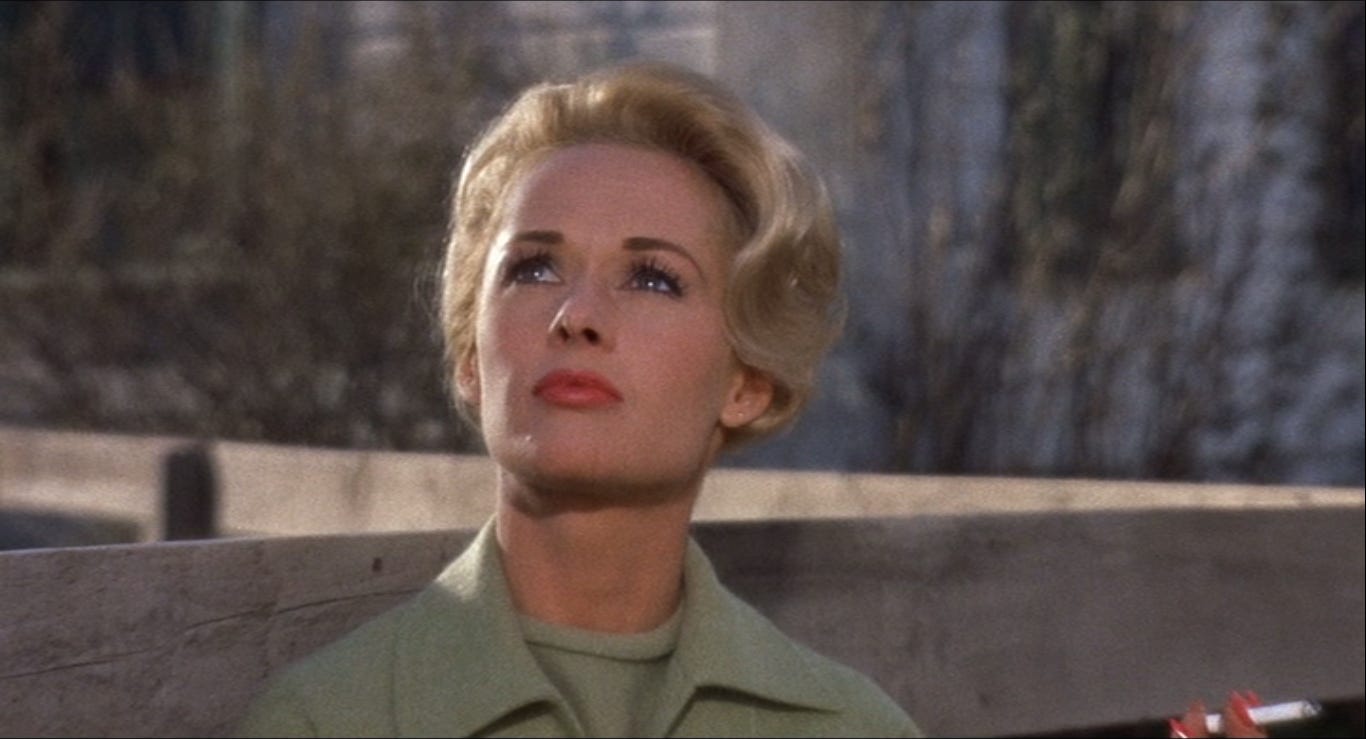
By the 1960s, Alfred Hitchcock had become the most famous movie director in the world. Via cameos, a much-watched television program, humorous trailers, and books and magazines bearing his name and image, he’d become a kind of brand name. Brands create expectations. For The Birds, his 1963 follow-up to the massive success of the 1960 thriller shocker Psycho, he embraced some while discarding others.
1. It’s not the film I thought it was.
It’s very possible this is just me, but I’d come to regard The Birds as one of the more minor of Alfred Hitchcock’s major movies. I had not seen it since college until rewatching it recently and I remembered it as an excellent film that nonetheless didn’t play to Hitchcock’s strengths. It’s more monster movie than suspense film. It offered little of the psychological complexity of Hitchcock’s other films. Tippi Hedren was no Kim Novak. Rod Taylor was no Cary Grant (well, that was fair). Wasn’t the opening kind of slow? Was there really any even subtext?
Boy did I get it wrong.
2. The opening credits sequence a mini-masterpiece onto itself.
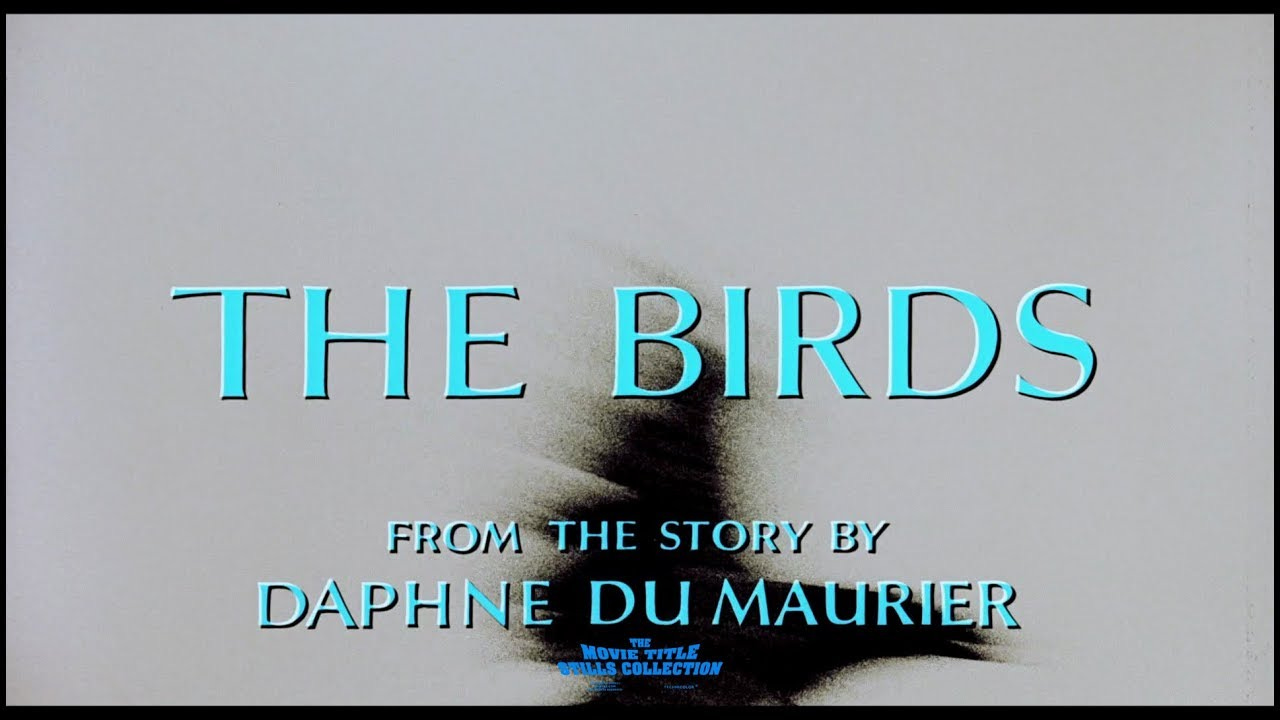
The silhouettes of birds flap frantically across a soft gray backdrop, accompanied by the sound of flapping wings, chirps and caws. I’m not sure how this was created. It appears to be images of real birds, but their movements are almost entirely on a two-dimensional plane, as if flying back and forth behind glass in a narrow space. It’s hard to find much information about titles designer James S. Pollak. He has credits on just one other film, The Wheeler Dealers (released, like The Birds, in 1963), though he apparently did uncredited work on the Grand Prix titles a few years later. Is he the same James S. Pollak who wrote the 1946 novel The Golden Egg, a satire of Hollywood? Maybe. Pollak would have been 37 at the time. He could have been a journeyman figure who wandered into creating titles for a few years then wandered out. Whichever the case, this a haunting and strange way to start the movie, made all the more unsettling by the cyan text and titles that fall together in pieces then fall apart just as quickly. In some ways, that process is just as apt a way to open this movie as the birds themselves.
3. What kind of film are we watching?
In the short Blu-ray documentary “Hitchcock’s Monster Movie,” horror scholar David J. Skal posits that, while not a monster movie itself, The Birds would not exist were it not for the giant monster movies of the 1950s. The formula, codified by films like The Beast from 20,000 Fathoms, Them!, Godzilla and others, involved beasts running amok and threatening civilization, usually as a result of science pushing nature too far. But is that really what’s going on here? Nature pushing back is posited as one explanation for the bird attacks, but not necessarily the most plausible reason in a film that never explains or resolves its central mystery. (More on that in a bit.) It’s another quote, this one in the feature-length doc All About the Birds, that unlocked something for me. Screenwriter Evan Hunter (probably now best known for the crime fiction he wrote under the name “Ed McBain”) claims he came on board after being told Hitchcock would be throwing out “everything but the title” of the Daphne du Maurier novella The Birds adapts and suggested beginning the film like a screwball comedy. *
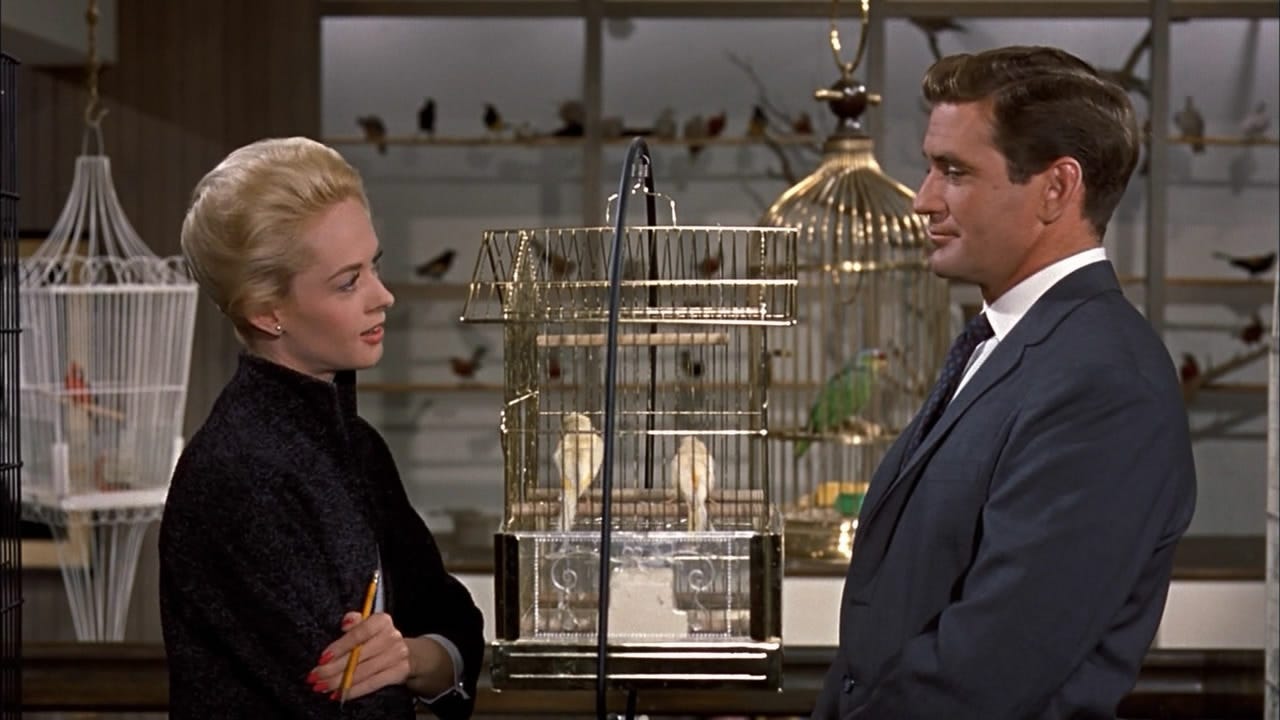
I’d never thought about it this way, but of course this is what’s going on in the film’s long lead-up to the first bird attack, a gull plunging at Hedren’s skull as she makes her way across Bodega Bay by boat. Hedren plays Melanie, the spoiled daughter of the publisher of a San Francisco newspaper. She has a meet-cute with Mitch (Taylor) in a pet store after Mitch recognizes her then plays along as she pretends to be an employee of the store, a mild example of the pranks that made her a semi-notorious figure. They bicker when she realizes he’s having her on and plots a kind of revenge by delivering the pair of lovebirds he was attempting to buy for his much younger sister Cathy (Veronica Cartwright). When told Mitch has left to spend the weekend at his family home in Bodega Bay, she follows him there.
It’s all classic screwball material. Melanie’s fur coat marks her as a high society outsider in the salt-of-the-earth community of Bodega Bay. She banters with Annie (Susanne Pleshette), a rival for Mitch’s affections. Yet it feels increasingly unsettling the longer it plays out. On page, it’s light comedy, but Hitchcock directs like, well, an Alfred Hitchcock film. When Melanie sneaks into Mitch’s family home while he’s out, everything about the scene suggests something horrible is about to happen. Then, when something horrible finally does happen, everything screwball goes out the window.
It’s incredibly spooky for reasons that are hard to pin down, a daring exercise in not giving the audience what they expect and repackaging the familiar in the form of the “wrong” genre. And yet, neither Hitchcock nor Hunter seems to have seen it this way. “Like all pictures of this nature, its personality didn't carry,” Hitchcock told Cinefantastique in a making-of article published in 1980. "If the picture [he always said ‘picture,’ never ‘film’] seems less powerful today than it did in 1963, that's the main reason, that the personal story was weak. But don't tell that to Evan Hunter.”
He went on to call Hunter not “the ideal screenwriter,” prompting a defensive response from Hunter in the same article (in which he also laments the presence of scenes written by an unknown hand):
“If there were weaknesses in my screenplay […] they should have been pointed out to me before shooting began, and they would have been corrected. I feel the weaknesses were manifold, but only some of them were in the script. The concept of the film was to turn a light love story into a story of blind, unreasoning hatred. Since Hedren and Taylor could not handle the comedy at the top of the film, the audience became bored. They had come to see birds attacking people, so what was all this nonsense with these two people, one who can't act and the other who's so full of machismo you expect him to have a steer thrown over his shoulder? Bad acting and — for Hitchcock — incredibly bad directing.”
The film, however, suggests both were wrong. Something about what we see feels off even before the birds begin attacking. When they do, it plays less like a shock than a confirmation that something is terribly wrong with what we’re watching.
4. The sound of no music…
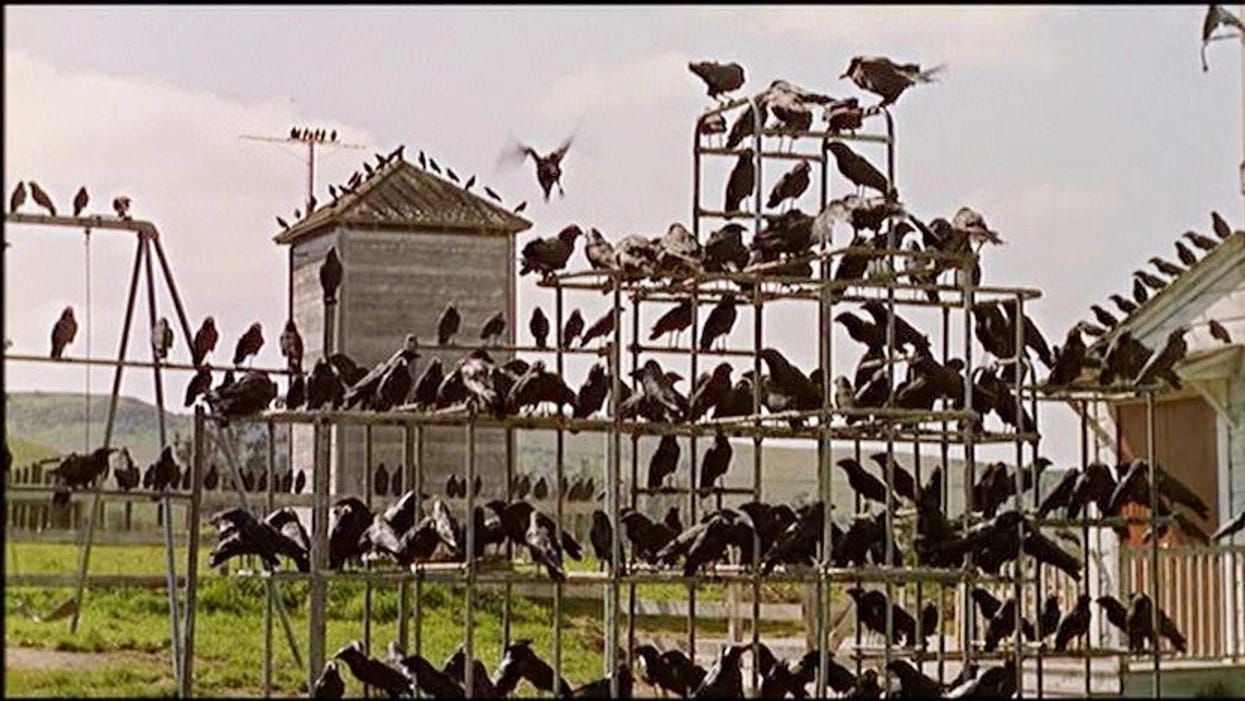
Hitchcock had a long partnership with composer Bernard Herrmann, who’s credited as a “sound consultant” here. But The Birds has no score, just an eerie absence that contributes to the airlessness of the screwball material that opens the film and makes every scene unbalanced and uneasy. Score music, particularly powerful, direct work like Herrmann’s, suggests how we should feel. The Birds offers no such guiding hand, which ends up making tense exchanges between characters feel heightened and the bird attacks more immediate.
5. …but not the sound of silence
Instead it’s bird noises that fill the sonic void. Well, not exactly bird noises. Hitchcock turned to Oskar Sala and Remi Gassmann to create bird effects using an early electronic synthesizer called the Trautonium. And by “early,” I mean decades for The Birds. The work of German engineer Friedrich Trautwein, the Trautonium was then refined by Sala, who continued to work with the instrument until his death until 2002. It’s an odd instrument, a kind of keyboard without keys that creates tones that fall somewhere between the sounds created by a Theremin and a Moog. It can be quite beautiful, in the right hands. Sala wasn’t interested in creating beautiful noises, however, crafting instead a bed of not-quite-nature cries and caws that contribute to the film’s unnerving effect. (There’s a short news item about Sala’s work on The Birds on YouTube. It’s in German. Yyou can turn the subtitles on.)
6. Natural’s not in it.
Bird noises that resemble but don’t exactly match bird noises we know fit perfectly into the design of the film. The film uses real birds but also dummies and visual effects. Some of the latter is the work of Ub Iwerks, the animator now credited as Mickey Mouse’s co-creator. Iwerks was nearing the end of his long second stint at Disney, while also working for other studios. One of his innovations was the sodium vapor process, which improved on bluescreen effects.
Improvement doesn’t mean perfection. The seams show in The Birds’ Oscar-nominated effects. But they also seem true both to the not-quite-natural sounds the birds make as well as the off-reality world of the film. Hitchcock disliked shooting on location, and though The Birds contains quite a few location scenes, it mixes them with those shot in the studio, sometimes against sweeping matte paintings. They’re not fully convincing, but they don’t have to be, just as the frictionless rear-projection driving scenes don’t have to look exactly right. I much prefer the stylized reality of these touches to many contemporary greenscreen effects that miss realism by a couple of inches and end up swallowed by the uncanny valley. As longtime readers and Next Picture Show listeners know, I could go on at length about my distaste for the idea of “dated” effects. I won’t continue this train of thought any further, but I think The Birds can be Exhibit A for my argument going forward. No, the effects don’t quite feel real. Why should they? You’re watching a movie. Reality is elsewhere.
7. Blondes have only slightly more fun.
The Birds has become a topic of much conversation in the past dozen years, first due to the HBO movie The Girl, which depicts Hitchcock as behaving abusively toward Hedren after she rejected his sexual advances, and again in 2016 when Hedren made even more unsettling claims in her memoir, Tippi. Though those claims fall outside the scope of this piece, there’s no reason not to believe her and they’re now part of the history of the film and hard to put out of mind when watching it. Whatever happened off screen, The Birds is certainly another Hitchcock film built at least partly around the undoing of an icy blonde, though at least Melanie makes it out of this one alive, unlike poor Marion in Psycho or the blondes of other movies. But spare a moment for Hitchcock’s non-blondes. or at least the blondes that don’t fit the mold. Barbara Bel Geddes’ fate in Vertigo, forgotten by both the protagonist and the film at the halfway point, looks kind to what happens to Suzanne Pleshette’s Annie here.
8. Love is an uneven polygon.
Melanie desires Mitch, despite her protestations. Mitch desires Melanie, despite his own. Annie still wants Mitch, even sticking around in Bodega Bay after the end of their relationship, brought about the icy behavior of Lydia (Jessica Tandy), Mitch’s mom. (Does Tandy smile once in this movie? Something to watch on a subsequent viewing.) Lydia fears being alone and clings to Mitch after the death of her husband. When Lydia tells Mitch he’s not the man his father was, it wounds him. Annie claims the situation can’t be read psychoanalytically, “With all due respect to Oedipus.” I’m not so sure. It’s all quite tense, vague, and unsustainable, a situation bound to fall apart and crush some of those involved. The drama plays out—sometimes at a simmer, sometimes at a boil—even as the bird attacks intensify. Are the birds, as John Carpenter has suggested, “a symbol of the tensions going on between the characters?”
9. What’s happening??!?? [Insert the appropriate Poltergeist gif here]
So, maybe the birds are a symbol of the tensions between the film’s characters. Or maybe they’re not? In one of the film’s best scenes, the customers at a Bodega Bay diner toss around options. Mrs. Bundy, a bird enthusiast (“ornithology happens to be my avocation”), can’t believe birds would attack humans but introduces the nature-in-revolt possibility anyway when she says, “It is mankind, rather, who insists upon making it difficult for life to exist upon this planet.” Or maybe, as another customer suggests, it’s the end of the world. Or maybe, as a terrified woman proposes after a subsequent attack in which all hell breaks loose, Melanie is to blame. “They say when you got here the whole thing started,” she tells the outsider, phrasing that suggests she’s not alone in this opinion. (We first see birds behaving suspiciously in San Francisco. Perhaps they followed her. Or maybe the love birds are to blame?) So which is it? Or is it none of the above? I don’t think the answer can be found in the film itself. These theories are thrown out in the midst of a busy diner against the backdrop of orders being taken. Characters talk over one another. It’s not quite a scene from a Robert Altman film, but the controlled chaos suggests a lot of ideas flying around with no firm ground upon which to land.
10. Never the end.
The first time I heard of Alfred Hitchcock was when a friend of my parents told me, in frustration, “his movies don’t have endings.” Pressed, she elaborated, “They don’t end right.” I wonder if she specifically had The Birds in mind? If so, she’s not that far off. The plan, until late in production, was to end the film with Mitch, Cathy, Lydia, and the battered Melanie making their way through a bird-filled town until they escaped Bodega Bay. Instead, it ends as it ends now, their fate unclear as they drive through a landscape filled with noisy birds who might be plotting against them and bathed in sunlight that could be on loan from a Biblical epic. And maybe Bodega Bay was just the first place to fall. Maybe there is no escape. The Universal logo that ends the film provides no answers. Originally Hitchcock didn’t even want this, but it almost feels necessary, a final reminder, as the last echoing caw fades from the soundtrack, that we’ve been watching a movie. Yet, as a punctuation mark, the logo plays more like and ellipses than a period. It’s the end, and yet…
* This is mostly true. Du Maurier’s novel depicts a similar bird uprising entirely from the perspective of a Cornish farmhand attempting to protect his family. Du Maurier’s descriptions of the birds’ attacks on the protagonist’s home, however, clearly inspired similar scenes in the film.
