DISCLAIMER

I claim no ownership of any images or writings posted here unless otherwise stated. i.e. [placed in brackets] All images and writings are owned/copyrighted by others. I make no income from their use and I am sharing them for the newsworthiness and/or cultural value they represent as well as for educational purposes. No infringement is intended and any media used is not for commercial purposes. If you are the person responsible for an image or writing that I have posted, please contact me in "comments," showing proper documentation and I will remove it immediately.

Search This Blog

Tuesday, July 1, 2025

THE SORROW AND THE PITY

Rent it on Amazon, Apple TV, Fandango at Home, Milestone and Google Play.

“The Sorrow and the Pity” is by far the most famous documentary by Marcel Ophuls. If all you know of the film is its use as a running joke in “Annie Hall,” then it is beyond time to take a look at Ophuls’s exhaustive, densely structured reconstruction of life in Clermont-Ferrand, France, during the Nazi occupation. The film has been credited with puncturing the postwar myth that France resisted German rule en masse.

Ophuls talks to resistors and admitted collaborators alike, from people who would have us believe they saw little or nothing to people who saw everything. Running nearly four and a half hours, the film is divided into two parts — “The Collapse” and “The Choice” — as it moves through how France laid down its arms against the Nazi invasion and then normalized the German presence. Witnesses discuss the attraction of fascism, loyalty to the Vichy puppet government, how movie screens remained illuminated (albeit with Nazi censorship) and how Paris, after the initial shock of capitulation, returned to a simulacrum of its vivacious self. One interviewee says that the Gestapo could not have been as destructive as it was without the help of the French police.

Part of Ophuls’s diagnosis is social. Pierre Mendès-France, a Jewish lieutenant with the French Air Force who escaped to Britain (and later, in the 1950s, served as the prime minister of France), says that it was easy for the Nazis to draw on latent antisemitism and anti-British sentiment in the country. Denis Rake, a Briton who worked in France as a secret agent during Vichy rule, points to class differences: He got the most help, he says, from railway workers. The bourgeoisie, by contrast, had more to lose.

We hear of divisions within the resistance itself — notably communist versus non-communist — and of the debates its members had about what actions to take. Ophuls shows how sentiment changed quickly after the liberation. And Emile Coulaudon, a resistance fighter who had the nom de guerre Colonel Gaspar, delivers a sobering assessment from the standpoint of more than 50 years ago: He warns of the “risk in the world of the reappearance of Nazism, or whatever goes by another name but is still Nazism.”

Monday, June 30, 2025

"GOODFELLAS": SCORSESE'S VISCERAL SYMPHONY OF AMERICAN CRIME

In the pantheon of American cinema, few works blaze with such ferocious authenticity and stylistic audacity as Martin Scorsese's "Goodfellas" (1990). This electrifying chronicle of mob life doesn't merely depict organized crime—it immerses us in its intoxicating rhythms, seductive pleasures, and inevitable moral collapse with such virtuosic filmmaking that we become complicit witnesses to its brutal beauty.

Scorsese, born to working-class Italian-American parents in Queens, brings an insider's intimate understanding to this adaptation of Nicholas Pileggi's "Wiseguy." The film embodies his career-long fascination with power, masculinity, Catholic guilt, and the dark underbelly of the American Dream. "Goodfellas" represents Scorsese at the absolute zenith of his powers, wielding every cinematic tool with breathtaking confidence to create a descent into the mafia underworld that feels simultaneously mythic and devastatingly real.

The film's propulsive energy stems from its revolutionary approach to narrative structure and visual language. Scorsese's camera never rests—it glides, swoops, and prowls through the criminal ecosystem with hypnotic fluidity. The legendary Copacabana tracking shot alone stands as a masterclass in technical bravura serving thematic purpose, as Henry Hill's seductive entry into the privileged realm of mobsters unfolds in one unbroken movement that pulls us into his intoxicating new reality.

Ray Liotta delivers a career-defining performance as Hill, capturing the character's evolution from wide-eyed aspirant to paranoid cocaine addict with remarkable precision. His voiceover narration—intimate, conspiratorial, and increasingly frantic—creates an unsettling complicity between protagonist and audience. Robert De Niro brings frightening stillness to the role of Jimmy Conway, his understated menace a perfect counterpoint to Joe Pesci's explosive Tommy DeVito—a performance of such volatile unpredictability that scenes vibrate with the possibility of imminent violence. Who can forget the‘How the fuck am I funny?’ routine.

The film's brilliant use of music deserves particular note. Rather than commissioning a traditional score, Scorsese weaves a tapestry of period-specific pop songs that function as emotional timestamps, charting the narrative's progression from the romantic doo-wop of the 1950s to the paranoid chaos of the 1980s.

"Goodfellas" transforms the gangster film from romanticized mythology into visceral anthropology. It depicts the mafia not as a shadowy organization of masterminds but as a dysfunctional workplace populated by volatile personalities governed by Byzantine codes of conduct. The film's genius lies in how it seduces us with the glamour and camaraderie of mob life before methodically stripping away the façade to reveal its hollow core.

Thelma Schoonmaker's revolutionary editing creates a rhythm that mirrors Henry's psychological state—elegant and measured in the glory years, increasingly fragmented and chaotic as his world disintegrates. The cocaine-fueled final day sequence remains an unparalleled depiction of paranoia, with its frenetic cutting and disorienting perspective shifts.

Three decades after its release, "Goodfellas" continues to reverberate through contemporary cinema and television, its DNA evident in works from "The Sopranos" to "Breaking Bad." Scorsese's masterpiece stands as both definitive gangster film and searing deconstruction of the genre.

As far back as I can remember, I always wanted to be a gangster.’ Ray Liotta’s opening line is the crime movie equivalent of ‘Once upon a time…’, and what follows is Martin Scorsese’s version of a fairy tale – the story of a starry-eyed Brooklyn kid who realises his boyhood dream and still comes out a schnook in the end. Based on the true life of mobster Henry Hill, Goodfellas was born in the shadow of The Godfather, but as the years go on, the question of which is more influential becomes mostly a matter of generation. Certainly, the former is more easily rewatchable, owing to its breakneck pacing – its two and a half hours (and three decades) just whiz by. And for a movie about violent career criminals, it’s also strangely relatable. Where Coppola went inside the walls of organised crime’s one percent, Scorsese’s gangsters are more blue collar. And as it turns out, working for the mafia isn’t much different than any other job - you spend 30 years busting your hump to climb the ladder, only to end up face down on a bloody carpet in some tacky house in the burbs. — Matthew Singer


Sure, it’s a rush – but is that enough? ‘Goodfellas’ is often heralded as Martin Scorsese’s masterpiece, and there’s no ignoring the full-throttle intensity and bravura visual style that underpin the real-life tale of small-time gangster Henry Hill (Ray Liotta) as he rises and falls through the ranks of the New York mob. It’s a film of perfect moments: Henry’s ‘As long as I can remember’ voiceover at the start; a breathtaking tracking shot through the back rooms of a nightclub; Joe Pesci’s unforgettable ‘How the fuck am I funny?’ routine.

But it’s hard to shake the feeling that, rather like its characters, ‘Goodfellas’ lacks heart. This is a story of awful creeps and the women who love them, so it was never going to be a festival of feelgood. But the sinuous coldness of the camerawork, the viciousness of the violence and the depth of the degradation all make it easy to admire, but hard to really love. In ‘Mean Streets’ and even ‘Taxi Driver’, Scorsese made his loser heroes relatable. In ‘Goodfellas’, they’re just a bunch of well-dressed dirty rats.
Written byTom HuddlestonMonday 16 January 2017

SCATTERED CLOUDS


Scattered Clouds
June 29th 2025

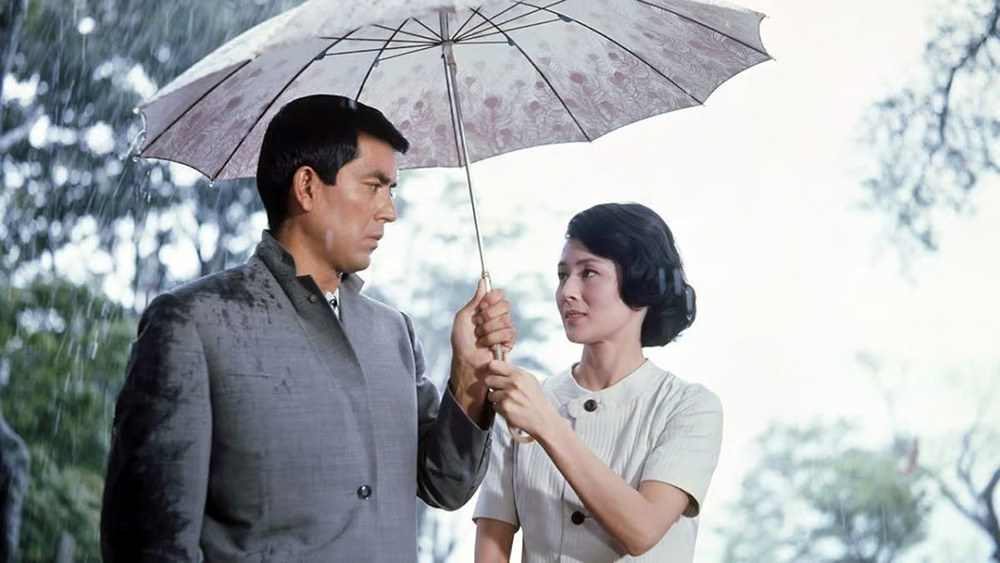
Mikio Naruse’s final film, Scattered Clouds (1967), follows Yumiko (Yoko Tsukasa), a woman whose life is upended when her husband dies in a sudden car accident caused by Shiro (Yuzo Kayama), a driver for hire. Despite being found not guilty in court, Shiro is consumed by guilt and offers his financial penance to Yumiko. She initially refuses. Legally disowned by her husband’s family and consequently stripped of his meager pension, she reluctantly returns to her rural hometown by Lake Towada, where her sister, also a widow, runs a hotel. Through sheer coincidence, Shiro’s work transfers him to the same area. Their paths cross once again, and a tense connection fraught with grief and unspoken attraction begins to blossom. Shiro and Yumiko’s fates are intertwined, yet reconciliation is impossible.

There is an abiding tension between personal grief and external expectations throughout Naruse’s oeuvre. Yumiko longs to mourn her husband in solitude, but her in-laws, sister, and even Shiro impose their own demands upon her: pushing her toward a second marriage, relocation, and financial pragmatism. Her desires clash with the demands of those around her to just move on from her husband’s sudden death. Despite Yumiko’s best efforts, her lack of agency and financial independence forces her to accept money she doesn’t want and leave Tokyo for the countryside. While starkly exposing the financial fragility of widowed women in 1960s Japan, Naruse captures the agony of being surrounded yet profoundly alone, where every well-meaning intervention only deepens an individual’s estrangement from their own feelings.

Naruse portrays the emotional and societal pressures faced by his characters with bluntness as they stubbornly move through life while privately struggling to process their tragedies. His restrained dialogue and prolonged glances convey more than words: Yumiko and Shiro’s interactions are charged with unspoken grief, shame, and longing. They both avoid facing the reality of their experiences by using alcohol, denial, and forced new beginnings to distract themselves, putting the ways people navigate the difficulties of life without truly confronting them on unfettered display. Shot on lush Tohoscope, the Lake Towada landscape contrasts with the film’s bleak themes of financial instability, widowhood, and the quiet agony of repressed emotions. Ultimately, Scattered Clouds is a poignant exploration of guilt, loss, the complexity of love, and the cruel irony of fate, underscored by Naruse’s signature restraint and empathy for the frailty inherent to the human condition.

Sunday, June 22, 2025

JAWS, 50 years on: ‘One of the truly great and lasting classics of American cinema’


MARK KERMODE, THE GUARDIAN

The true meaning of Jaws has been picked over by critics and academics ever since its release in June 1975, and even its status as the first summer blockbuster has been questioned. But isn’t it just about a killer shark?
First things first; Jaws is not about a shark. It may have a shark in it – and indeed all over the poster, the soundtrack album, the paperback jacket and so on. It may have scared a generation of cinemagoers out of the water for fear of being bitten in half by the “teeth of the sea”. But the underlying story of Jaws is more complex than the simple terror of being eaten by a very big fish. As a novel, it reads like a morality tale about the dangers of extramarital sex and the inability of a weak father to control his family and his community. As a film, it has been variously interpreted as everything from a depiction of masculinity in crisis to a post-Watergate paranoid parable about corrupt authority figures. But as a cultural phenomenon, the real story of Jaws is how a B-movie-style creature-feature became a genre-defining blockbuster that changed the face of modern cinema. In the wake of the epochal opening of Jaws 40 years ago, the film industry would find itself on the brink of a brave new world wherein saturation marketing and mall-rat teen audiences were the keys to untold riches. To this day, many consider the template of contemporary blockbuster releases to have been laid down in the summer of 1975 by a movie that redefined the parameters of a “hit” – artistically, demographically, financially.

According to David Brown, one of the film’s producers: “Almost everyone remembers when they first saw Jaws. They say, I remember the theatre I was in, I remember what I did when I went home – I wouldn’t even draw the bathwater.” I was no exception. I first saw the movie at the ABC Turnpike Lane in north London at the age of 12. It was a Sunday afternoon and I’d had to catch two separate buses to get to the cinema. I sat on the right-hand side of the packed auditorium and I remember very clearly finding the opening sequence so alarming that I wasn’t sure I’d be able to get through the rest of the film. As I told director Steven Spielberg several decades later, watching poor Susan Backlinie being dragged violently back and forth by an unseen underwater assailant, screaming blue murder, I genuinely feared that I would lose control of my bodily functions (“I like that!” laughed the director).


The lenient A certificate had meant that I’d been able to see the movie on my own, without an accompanying parent or guardian, merely the warning that “the film may be unsuitable for young children”. But the entire cinema seemed utterly traumatised by that unforgettable opening sequence, and in the wake of this ruthlessly efficient curtain-raiser (you see nothing, but fear everything), two people hurried to the exit. As they left, I remember whispering to myself in a state of sublime terror: “I am never going swimming again, I am never going swimming again…”
Jaws official trailer.

This, of course, had been the reaction of millions of cinemagoers in the US, where Jaws had become a summer movie sensation. In his influential essay, The New Hollywood, film historian Thomas Schatz notes that Jaws “recalibrated the profit potential of the Hollywood hit and redefined its status as a marketable commodity and cultural phenomenon as well”. Significantly, it achieved this success at a time when “most calculated hits were released during the Christmas holidays”. Not so Jaws, which according to David Brown was “deliberately delayed until people were in the water off the summer beach resorts”. Indeed, one of the film’s most memorable tag-lines was “See it before you go swimming!”. Yet it wasn’t just the resorts where Jaws showed its box‑office teeth.

Despite the fact that the summer months had traditionally been slow for cinemas (why go to the movies when the sun is shining?), Spielberg’s brilliantly constructed shocker struck a nerve with young audiences whose natural environment was not the beach but the shopping mall. Between 1965 and 1970, the number of malls in America had grown from 1,500 to 12,500 and Jaws rode high on the growing wave of multiplex cinemas that these urban meccas increasingly housed. Along with confirming “the viability of the summer hit, indicating an adjustment in seasonal release tactics”, Schatz also argues that Jaws struck a chord with a new generation of moviegoers who had “time and spending money and a penchant for wandering suburban shopping malls and for repeated viewings of their favourite films”. It didn’t hurt that these malls were air-conditioned, with the multiplex cinemas they increasingly housed providing a cool alternative to the sweltering summer heat.

In the wake of Jaws’s extraordinary success, film-makers and studios started to see the summer months not as dog days but as prime time, something that had previously only been true for the declining drive-in market. “The summer blockbuster was born on 20 June 1975, when Jaws opened wide,” wrote the Financial Times’s Nigel Andrews, adding: “In the years after Jaws, the entire release calendar changed.”

This change was apparently confirmed two years later by the May 1977 opening of George Lucas’s Star Wars, with its sequels The Empire Strikes Back and Return of the Jedi setting new benchmarks for seasonal franchise profitability. In the process, Steven Spielberg and George Lucas became two of the most influential people in Hollywood, the men who, according to popular folklore, had invented the “summer blockbuster”.
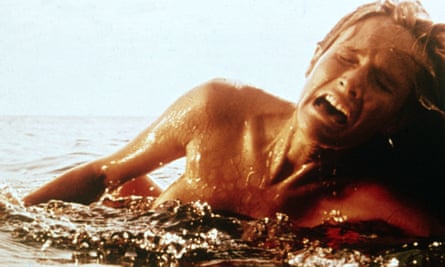
A still from the opening sequence of Steven Spielberg’s classic Jaws. Photograph: Fotos International/Getty Images

Jaws opened across North America on 464 screens amid an unprecedented publicity blitz: $2.5m was spent on promotion, a substantial chunk of which went on TV advertising, still a novelty at that time. Promotional tie-ins, including Jaws-themed ice-creams, were everywhere. I remember being on holiday in the Isle of Man long before the film’s UK opening (it didn’t arrive here until December) and buying the novel, the T-shirt and a garish Jaws pendant, all on the strength of the insane levels of news coverage that the film’s US opening provoked. “Lifeguards were falling asleep at their stations,” remembered the film’s other producer, Richard Zanuck, “because nobody was going in the water; they were on the beach reading their book”. In the first 38 days of its release, Jaws sold 25m tickets; its rentals in 1975 were a record-breaking $102.5m. When adjusted for inflation, the film’s total worldwide box office is now estimated at close to $2bn.

Such staggering success proved game-changing, establishing the financial merit of the “front-loading” strategy, which used saturation marketing to turn a movie into an event. According to Carl Gottlieb, who shares Jaws’s screenwriting credit with Peter Benchley: “That notion of selling a picture as an event, as a phenomenon, as a destination, was born with that release.”

Today, received wisdom has it that Jaws essentially redefined the economic models of Hollywood. This change led to some staggering box-office bonanzas, but it has come at a price. “My husband keeps citing this as the movie that changed the way movies are made,” says Jaws actress (and wife of former Universal boss Sid Sheinberg) Lorraine Gary (Ellen Brody) in the 1997 BBC documentary In the Teeth of Jaws. “It got us to where we are today, which is, if it’s not a hundred-million-dollar movie, it doesn’t get the kind of support it needs from the studio. It was a good thing at the time [but] it’s an awful legacy to now have everyone used to an enormous hit-you-over-the-head television campaign which costs so much money.”

Whether or not Jaws really did change the film industry for ever is one of the subjects to be debated at the Jaws 40th Anniversary Symposium at De Montfort University, Leicester, later in June. Here, prominent academics Peter Krämer and Sheldon Hall will go head to head on the still-heated question of whether Jaws was indeed the “first blockbuster” (Hall thinks not), while others debate subjects as esoteric as “masculinity and crisis in Jaws”, “Jaws and eco-feminism” and (most tantalisingly) “Jaws: the case of the archetypal American villain as queer dissident attacking the heteronormative”.

Conference convener Ian Hunter says that the purpose of the event is to investigate the movie’s progress from popcorn hit to cinema classic. “The thing about Jaws is that it’s open to so many interpretations,” says Hunter. “It can be about Watergate, or the bomb, or masculinity, or whatever. Some critics have claimed that it marks the point that Hollywood became more interested in archetypes than characters, but it was also the birth of a new kind of family film. I remember seeing it in Plymouth on Boxing Day 1975 and thinking that this was really a film for us, for the generation of The Towering Inferno and Earthquake, offering the kind of thrills that had previously been the domain of X-rated movies. For me, it remains one of the truly great and lasting classics of American cinema, a perfect piece of movie-making.”
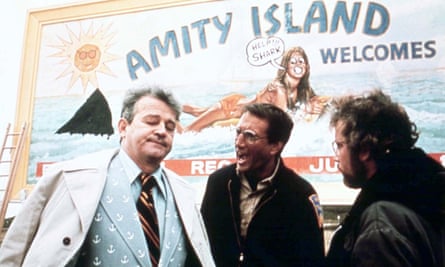
Murray Hamilton as the mayor of Amity, with Roy Scheider as police chief Brody and Richard Dreyfuss as Matt Hooper. Photograph: www.ronaldgrantarchive.com

Jaws began life as a 1974 novel by Peter Benchley about a seaside resort named Amity that is terrorised by a great white shark. Police chief Martin Brody, played by Roy Scheider in the film, orders the beaches to be closed, but the mayor and local businessmen insist they stay open – with tragic results. Eventually, Brody is forced to take to the sea with professional shark hunter Quint (Robert Shaw) and ichthyologist Matt Hooper (Richard Dreyfuss) to hunt down the shark and save the town.

Film rights were secured by Zanuck and Brown for $150,000 (plus $25,000 for a first draft of the script) before the novel had been published (the book sold 5.5m copies before the movie opened). After potential director Dick Richards reportedly blew the assignment by repeatedly referring to the shark as “a whale”, the producers turned to rising director Steven Spielberg, who had just finished work on his feature debut, The Sugarland Express, and had made waves with the TV movie Duel, which pitted an emasculated Dennis Weaver against a giant, predatory truck.

“I always thought that Jaws was kind of like an aquatic version of Duel,” Spielberg told me in 2006, when I interviewed him for a BBC Culture Show special on the eve of his 60th birthday. “It was once again about a very large predator, you know, chasing innocent people and consuming them – irrationally. It was an eating machine. At the same time, I think it was also my own fear of the water. I’ve always been afraid of the water, I was never a very good swimmer. And that probably motivated me more than anything else to want to tell that story.”

The production of Jaws proved problematic from the outset. First, there was the screenplay, which was still in flux when principal photography began in May 1974 (Richard Dreyfuss famously declared: “We started without a script, without a cast and without a shark”). Three drafts of the Jaws script were produced by Benchley before playwright Howard Sackler was brought in to do uncredited rewrites. But still things weren’t quite right and 10 days before the shoot Carl Gottlieb was enlisted to work with Spielberg on some dialogue scenes, bringing more warmth and “levity” to the often unlikable characters. Gottlieb would continue to do rewrites throughout the production, often incorporating material improvised in rehearsal by the cast, with added input from John Milius.

With a projected budget of between $3.5m and $4m, filming got under way at the Massachusetts resort of Martha’s Vineyard. Several residents were cast in minor roles, but a few feathers were ruffled by the prospect of a Hollywood production rolling into town. “Martha’s Vineyard is a very upmarket place,” says Nick Jones, producer/director of In the Teeth of Jaws. “There is a somewhat snobby element of the super-rich, but the businesses rely on tourist dollars. So there was a little tension between those who wanted the film crew there and those who didn’t. For example, when the production needed to build Quint’s shack on a vacant harbour lot, they were refused planning permission even though it was only a set. Finally, they were allowed to continue on the proviso that they put everything back exactly the way it was, including the trash!”
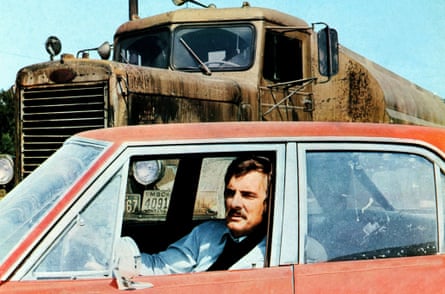
Dennis Weaver in Spielberg’s TV movie Duel, in which a monster truck plays predator. Photograph: Allstar/UNIVERSAL TV/Sportsphoto Ltd./Allstar

Nowadays, Martha’s Vineyard attracts a steady stream of tourists eager to visit the locations where Jaws was filmed. “It really is like walking around a movie set,” says Jones. “Before Jaws, there was a certain notoriety from the Ted Kennedy Chappaquiddick scandal, but the movie really eclipsed that. When we were making the documentary, we went with Lee Fierro [the Martha’s Vineyard resident who plays Mrs Kintner in the movie] to the stretch of coast where the beach scenes for Jaws were filmed. It’s very exciting to see those vistas that have become so iconic. And we got taken out to the wreck of the Orca [Quint’s boat], which was just a shell sticking out of the edge of the water. It was bizarre; we stood in it and touched it – it was like touching a piece of the true cross.”

The Jaws shoot was originally scheduled for 55 days, but the production swiftly turned into a logistical nightmare when the mechanical shark (three full-size, pneumatically animated models were constructed) consistently failed to play ball. Nicknamed Bruce after Spielberg’s lawyer, Bruce Ramer, the shark had been built by Bob Mattey, who had created the giant squid for 20,000 Leagues Under the Sea. The models worked fine in the warehouse, but the minute they were dumped into seawater, they started to malfunction. Day after day went by without any usable footage being shot, storms and seasickness the film-makers’ only reward.

Recalling the ordeal of the shoot, Spielberg told me: “Jaws to me was a near-death experience – and a ‘career death’ experience! I went to a party on Martha’s Vineyard and a very well-known actress came over to me and said, ‘I just came back from LA and everybody says this picture is a complete stinker. It’s a total failure and nobody will ever hire you again because you’re profligate in your spending and you’re irresponsible. Everybody’s calling you irresponsible!’ I had never heard the scuttle before, I didn’t ever hear the noise that was coming from Hollywood about me. So I was halfway through shooting the picture and this person tells me that my movie’s a disaster, and I am a disaster, and it’s over. And I really believed for the second half of the film that this was the last time I was ever going to shoot a film on 35mm.”

The lengthy shoot took its toll on the cast too. In particular, tensions emerged between Dreyfuss and Shaw to match those between their respective characters, ichthyologist Matt Hooper and crusty shark-hunter Quint. Partly modelled on local character Craig Kingsbury (who has a small role in the movie as the ill-fated Ben Gardner), Quint is a hard-drinking troublemaker who takes pleasure in taunting his city boy colleagues. It was a role into which Shaw threw himself with scene-stealing gusto, to the alarm of Dreyfuss. “There was a kind of sparring that went on between us,” Dreyfuss told the BBC in 1997. “It was both playful and – on my part – desperate. [Shaw] knew how to dish it out so you had to learn how to dish it back. He could be very vicious and his humour could be very cutting.” And, like his character, Shaw enjoyed a drink.
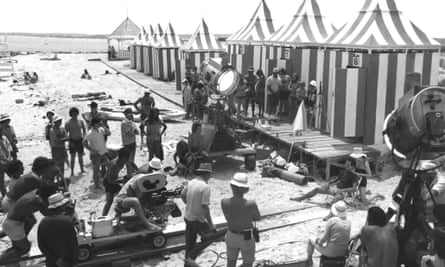
 The filming of the famous dolly zoom shot (pioneered in Hitchcock’s Vertigo) on the beach. Photograph: MPTVA/HA/LFI

But while Shaw proved a somewhat volatile presence, his work on screen was note-perfect, which was more than could be said for the shark. By the time the film-makers had enough usable footage in the can, the production was more than 100 days over schedule, with the budget spiralling toward the $9m mark, $3m of which had been blown on what Spielberg derisively called “the special defects department”. Yet Bruce’s failure to function proved the making of the film. Unable to get the shark action shots he wanted, Spielberg was forced to take a more Hitchcockian approach, working with editor Verna Fields to conjure tense sequences in which what we don’t see is more important that what we do. Meanwhile, composer John Williams filled in the gaps where the shark should be with an ominous score that has become as synonymous with screen terror as Bernard Herrmann’s themes from Psycho. The result was pure magic, causing Spielberg to concede that “had the shark been working, perhaps the film would have made half the money and been half as scary”.

It wasn’t until Jaws was test-screened at the Medallion theatre, Dallas, in March 1975 that the film-makers got the sense that they were on to a hit. “That was the first time I realised that the shark worked, the movie worked, everything about it worked,” Spielberg told me. “The audience came out of their seats. Popcorn was flying in front of the screen twice during the movie. And then I got greedy and thought, gee, could I make the popcorn fly out of their boxes three times? And that’s when I shot that scene in my editor Verna’s pool. I had this idea that maybe when Richard [Dreyfuss] goes underwater to dig the tooth out [of the sunken boat], what if Ben Gardner’s entire head comes out of the hole? And so I shot it in her pool with a prosthetic head and a plywood boat.”

The scene of Ben Gardner’s mutilated head floating into view did indeed prove a showstopper. It was just one of a number of intense, gory sequences that earned Jaws the reputation of being the most shocking movie ever to be awarded a family-friendly PG rating in the US. Writing in the Los Angeles Times, critic Charles Champlin complained that “the PG rating is grievously wrong and misleading… Jaws is too gruesome for children and likely to turn the stomach of the impressionable at any age.” (The Motion Picture Association of America defended its lenient rating by pointing out that “nobody ever got mugged by a shark”.)

All of which brings us back to the thorny question of what Jaws is really about. For years, I have insisted that Jaws is a classic monster movie “morality tale” in which the watery fate of potential victims is sealed by their on-land behaviour. Stephen King memorably wrote: “Within the frame of most horror tales we find a moral code so strong it would make a Puritan smile”, and that certainly seems to apply to Jaws. Key to this reading is the character of Hooper, who [plot spoilers ahead!] dies in the novel after having a sordid fling with Brody’s wife, Ellen, but miraculously survives on screen, largely because the affair doesn’t happen in the film. Benchley, who makes a cameo appearance in the movie as a news reporter, remembers that the very first thing Zanuck told him when writing the script was to lose “that love story, the whole sex nonsense”. Spielberg agreed, confirming to me that “my first impulse was to get rid of the melodrama and the soap opera aspects of the novel, the whole love affair with the ichthyologist and the police chief’s wife”. Instead, he wanted to “go right for that third act”, cutting to the chase with dramatic results. But once the affair had been removed, so too was the subtextual justification for Hooper’s violent death.
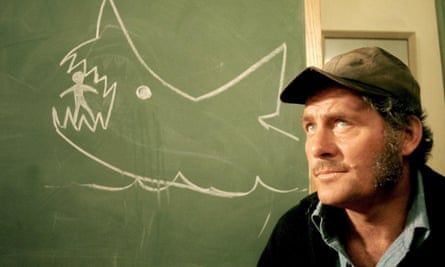
Robert Shaw as Quint, the fisherman who agrees to hunt down the shark, in Jaws. Photograph: Everett/REX_Shutterstock

Although the official explanation for Hooper surviving the shark-cage attack was the unplanned wrecking of the empty cage by a real-life predator (and stuntman Carl Rizzo’s understandable reluctance to get back in the water), it seemed clear to me that without the infidelity subplot Hooper became a heroic character who had to live. When I interviewed Spielberg in 2006, he reluctantly conceded that there was some logic in this. But by the time I spoke to him again in 2012, for BBC Radio 5 Live, he wasn’t buying it.

“The shark doesn’t care whether you’re married or single,” he laughed. “It just wants to eat ya!” But what about Hooper’s survival? I insisted. Surely that only makes sense because you cut out the affair? “Well, I cut the soap opera because I wanted to go out and do a sea-hunt movie,” Spielberg demurred. “I wasn’t interested in doing Peyton Place.”

So, Jaws isn’t a film about infidelity? (Or masculinity? Or Watergate? Or whatever?)

“No,” replied Spielberg definitively. “It’s a film about a shark.”

How JAWS Made a Template for the Modern Blockbuster

Peacock/Universal Pictures, via Associated Press


Much more than a mere creature feature, “Jaws” created a playbook that filmmakers have followed closely for 50 years.


By Rumsey Taylor and Eve Washington

The reporters cataloged more than 50 films, which include scores of deaths by sharks, dinosaurs, piranhas, anacondas, spiders, "Graboids," tornadoes, aliens and more sharks.June 18, 2025

Fifty years ago, Steven Spielberg’s “Jaws” terrified moviegoers. Its shocks still reverberate.

Its blueprint is now so recognizable that you have probably seen “Jaws” — even if you haven’t actually seen “Jaws.”

Here’s a breakdown of the plot (spoilers abound):

A mysterious creature


… stalks …

a remote island


… and attacks …

a nameless victim.


Next …

a reluctant hero


… challenges …

the town mayor


… and enlists …

a couple of experts.


Finally …

a major sacrifice


… leads to …

the final confrontation


… and …

the creature’s death
(it’s blown up).

Those nine points are what make “Jaws” “Jaws.” Put together the right way, they maximize suspense and spectacle without losing the human stakes.

“Jaws” didn’t invent the creature feature. By 1975, there had been 15 Godzilla movies and four King Kongs, as well as dozens of Hammer and Universal horror films, including “Creature from the Black Lagoon” in 1954. And Mr. Spielberg’s film included techniques popularized by other filmmakers, including Alfred Hitchcock and the famed B-movie producer Roger Corman.

Even if other films put similar elements into practice, none were as phenomenally successful as “Jaws,” boosted by a large budget and given a wide release on June 20, 1975.

The  creature stalks the remote location and attacks the first victim . Next, the reluc­tant hero challenges the local authority and enlists the experts . Finally, the sacrifice leads to the con­frontation and the crea­ture’s death .

Jaws1975
A great white shark stalks an
island and attacks a skinny­dipper . Next, a
policeman challenges the
mayor and enlists a scientist and hunter . Finally, the hunter’s death leads to a boat
attack and the shark’s death .

Alien1979
An
alien stalks a
spaceship and attacks an
officer . Next, the warrant officer challenges the
computer and enlists the science officer . Finally, the captain’s death leads to a
fight and the alien’s death .

Nope2022
A
U.F.O. stalks a rural
area and attacks a ranch
owner . Next, the rancher’s children challenges an impresario and enlists two
experts . Finally, one expert’s death leads to a
trap and the U.F.O.’s death .


These elements worked so well that dozens of films since then have more or less followed its playbook, to varying degrees of success.

To capture how widely “Jaws” has influenced Hollywood, we watched over 50 films that include most or all of those nine points.

Some are direct knock-offs, like “Great White” (1982), which was pulled from theaters after the distributor of “Jaws” claimed copyright infringement.

Others used the “Jaws” structure in new genres. “Alien” (1979) is said to have been pitched as “‘Jaws’ in space.”

This template can even be seen in films as recent as “Nope,” from 2022.


Wednesday, May 28, 2025

The Three Musketeers and The Four Musketeers

The two-part Dumas adaptation, being released by the Criterion Collection in a 4K restoration, features a superb cast—including Michael York, Raquel Welch and Charlton Heston—and the director’s classic wit.

By
David Mermelstein

Few works have sparked the cinematic imagination as routinely as Alexandre Dumas’s 1844 novel “The Three Musketeers.” A hasty count indicates some 40 movie versions (the first and latest from France, in 1903 and 2023) and many more made just for television. But by common consent, the best yet is Richard Lester’s “The Three Musketeers” (1973) and “The Four Musketeers” (1974), originally conceived as a single film with intermission but ultimately released as two separate pictures. Both have now been fetchingly restored in 4K and this week debut on home video in that form as part of the Criterion Collection. (Enthusiasts may select a two-disc Blu-ray set or a four-disc 4K UHD/Blu-ray combo pack.)

The Philadelphia-born Mr. Lester worked primarily in the U.K. and remains best known today for “A Hard Day’s Night” and “Help,” his mid-1960s filmed collaborations with the Beatles. At an early stage, there was apparently some thought of casting the Beatles as Dumas’s sword-fighting trio plus their protégé D’Artagnan—an idea quickly quashed.

Instead, thanks in large part to the independent European-based producers known collectively as the Salkinds (specifically Ilya and his father, Alexander), a host of Hollywood and British stalwarts not only assumed the leads but also most of the supporting roles. Three seasoned actors in their prime—Oliver Reed, Richard Chamberlain and Frank Finlay—were cast as the world-weary musketeers: Athos, Aramis and Porthos. Michael York, fresh from his central role in the soon-to-be Oscar-winning “Cabaret,” nabbed the plum part of the callow D’Artagnan (ultimately, the fourth musketeer), who spends nearly as much time bedding beautiful women as engaging in derring-do.
Michael York and Raquel Welch PHOTO: CRITERION COLLECTION

Yet these iterations of 17th-century masculinity were in many ways outshone by their colleagues in character roles. The Salkinds already had a professional relationship with Raquel Welch, the very essence of feminine sexuality at the time, so her participation—as Constance, the queen’s dressmaker and the object of D’Artagnan’s ceaseless affections—was non-negotiable. Who knew then that this screen goddess, often as not wooden in dramatic parts, had talent as a comedic foil? Mr. Lester brought this gift to the fore by having her underplay the yuks.

Landing Faye Dunaway after “Bonnie and Clyde” but before “Chinatown” and “Network” was a coup, and she portrays the ruthless Milady de Winter, an agent of much misery, with such unforgettable hauteur that it’s hard to imagine anyone else inhabiting the role. Christopher Lee lends her lover, the fearsome one-eyed Comte de Rochefort, exactly the kind of menace that made him irreplaceable on screen for so many decades.
Faye Dunaway PHOTO: CRITERION COLLECTION

Mr. Lester opted for subtlety in selecting the royal couple. Dubbed into English by Richard Briers, the prolific French actor Jean-Pierre Cassel proves convincingly wry and appealingly oblivious as Louis XIII. And Geraldine Chaplin brings an appropriately cool mien to Queen Anne, who cares little how her actions affect others, let alone the nation.

But the real casting masterstroke was placing Charlton Heston, one of Hollywood’s leading leading men, in the pivotal role of Cardinal Richelieu, the power behind the throne and the figure discreetly controlling most of the saga’s action. Heston plays Richelieu with a welcome light touch, giving just the right weight to sotto-voce comments, asserting authority by never raising his voice and letting an arched eyebrow or a sidelong glance serve his character’s needs. The actor was initially courted to play one of the musketeers, but both Heston and Mr. Lester soon came to appreciate that veering from the obvious was the smarter move.
Charlton Heston PHOTO: CRITERION COLLECTION

In other ways, too, these films depart from the predictable without ever sacrificing what’s elemental. So, yes, there’s plenty of acrobatic swordplay in these pictures—much of it seemingly influenced by the martial-arts movies then all the rage in Hong Kong—as well as gorgeous, period-accurate costumes, all but Welch’s courtesy of Yvonne Blake, to say nothing of Brian Eatwell’s splendid production design. (The films were shot entirely in Spain, though tells are few.) But to all this Mr. Lester has added his trademark antic charm and off-kilter wit. No one familiar with his earlier pictures will fail to spot those qualities here: the offscreen ambient noises and cross-talk; the use of multiple cameras for a single scene; and the strange objects that routinely appear, including a working organ in the middle of a garden and a carousel powered by peasants. And who can forget that royal chess match in which live dogs substitute for rooks, knights, pawns and the like?

Let’s have a word, too, for the screenwriter, the Scottish author George MacDonald Fraser, whose early “Flashman” novels, with their outlandish bounder protagonist, served almost as dry runs for his spirited condensing of Dumas’s massive chronicle into two efficient pictures, each running less than two hours. It was Fraser who, when Mr. Lester asked how a particular scene should look, said, “like a Breughel painted by Rembrandt”—a comment the director clearly took to heart.

None of this makes these pictures high art, but they are consummate entertainment. Few of us want a meal of Bergman and Bresson every night. Sometimes, the menu calls for romance, intrigue, broad comedy, gaudy settings, lavish dress, and, of course, sexy women and dashing men. And when you want to dine out on that, Mr. Lester is happy to serve you.

Monday, May 26, 2025

E.T.


On May 26, 1982, Steven Spielberg unveiled E.T., The Extra-Terrestrial at the Cannes film festival. The sci-fi classic would become a summer smash en route to four Oscar wins at the 55th Academy Awards. The Hollywood Reporter’s original review is below:

Jaws. Close Encounters of the Third Kind. Raiders of the Lost Ark. And now, E.T., The Extra-Terrestrial. Steven Spielberg has done it again. He has created another instant American classic.

As director and co-producer (with Kathleen Kennedy), Spielberg has crafted with warmth and humor a simple fantasy that works so superbly on so many levels that it will surely attract masses of moviegoers from all demographics. At the heart of the story line, E.T. is really My Favorite Martian, with a bizarre-looking but disarmingly lovable alien (designed by Carlo Rambaldi, who designed the creature in Close Encounters).

However, the film goes past the myth of a marooned spaceman trying to figure out a way back home. While E.T. is being befriended, hidden and protected (from the adults) by his Earth buddies, the picture conveys a relationship story, an adventure, a mystery, and ultimately, the time-worn but always timely message that no matter how different God’s creatures may be, there’s a common bond between the thinking ones — because they’re also capable of love. Sometimes, kids are always the ones to recognize this on a more immediate level than adults.

Sound sappy? Yes. But Spielberg’s magic as a director is to take these themes and weave them into a straight-forward tale so delicately that you are never sledge-hammered and come to perceive screenwriter Melissa Mathison’s intent through the exquisite subtlety of this beguiling fairy tale.

Amid the wonder, excitement and joy that virtually every frame of this picture elicits — swept along by John Williams’ playful and uplifting score — one really does fall in love with the delightful little alien, and indeed, finds oneself reaching for the handkerchief (and realizing but not minding upon later reflection) right on cue. Never mind that certain plot leaps of faith are necessary to advance this fantasy along, the characters (mostly kids) are so compelling and endearing that you’re easily pulled in.

Thursday, May 15, 2025

ALL ABOUT MY MOTHER


How many mothers can you fit into 101 minutes of film? Well, that depends on how you define what a mother is. A biological womb? A nurturing guardian? A dependable caretaker? An emotional support cheerleader? A homebase to return to? A financial backer? A character role to embody, or an archetypal performance? All About My Mother (1999) showcases all of these mothers (and more) in a layered portrait dedicated to "all actresses who've played actresses, to all women who act, to men who act and become women, to all who wish to be mothers." In his Oscar-winning film, Pedro Almodóvar's many leading ladies blur the definitions of motherhood into a single Matryoshka-like narrative, with roles nested within roles, and each woman becoming a slightly modified version of the others and of herself.

All About My Mother pays explicit homage to the film All About Eve (1950) and the play A Streetcar Named Desire (1947) by weaving them directly into the script, creating an overlapping picture of women echoing each other. Manuela (Cecilia Roth), a single mother in Madrid, works as a nurse who sometimes helps young doctors simulate the experience of asking grieving relatives to donate their loved ones' organs. When she takes her son, Esteban (Eloy Azarín), to see a performance of A Streetcar Named Desire for his seventeenth birthday, his earnest attempts to get an autograph by the show's star, Huma Rojo (Marisa Paredes), are ignored as she drives away from the theater. In a direct nod to the same scene from John Cassavetes's Opening Night (1977), Esteban is struck down by another car without ever getting the autograph he so desperately wanted. At the same hospital where she performs as a grieving mother, Manuela is now forced into the role for her own personal tragedy.

To distract her from her son's haunting memory, Manuela moves back to Barcelona to find the father Esteban never knew he had: a trans woman named Lola (Toni Cantó) who Manuela had left after finding out she was pregnant. But nobody in Barcelona knows where Lola is. After finding her old friend Agrado (Antonia San Juan), a feisty trans sex worker, and meeting Rosa (Penélope Cruz), an optimistic young nun who helps all the "hookers and transvestites" until she discovers she's HIV-positive and pregnant with Lola's child, Manuela finds herself in a complicated web that links her past, her present, and the ghosts of futures she could have had. Drawn to rewatching Streetcar performances at the theater, she becomes embedded in Huma's life and the play itself, the same scenes repeating nightly. They're the same roles Manuela and Lola had played 20 years earlier when they had first met in a theater troupe. Now though, Manuela is reliving the same lines with no evidence to hold onto about all that's happened in between: her marriage to Lola, Lola's new breasts, their secret son, his tragic death. And yet, everything around Manuela is a series of interconnected quotes in a tight feedback loop of references. Losing her son doesn't rob Manuela of motherhood. Unexpectedly, she both is cared for by, and takes care of, a whole chosen family of women trying to be, have, and deliver the same maternal role that they each need from each other, in their own ways.

Thursday, February 6, 2025

MODERN TIMES


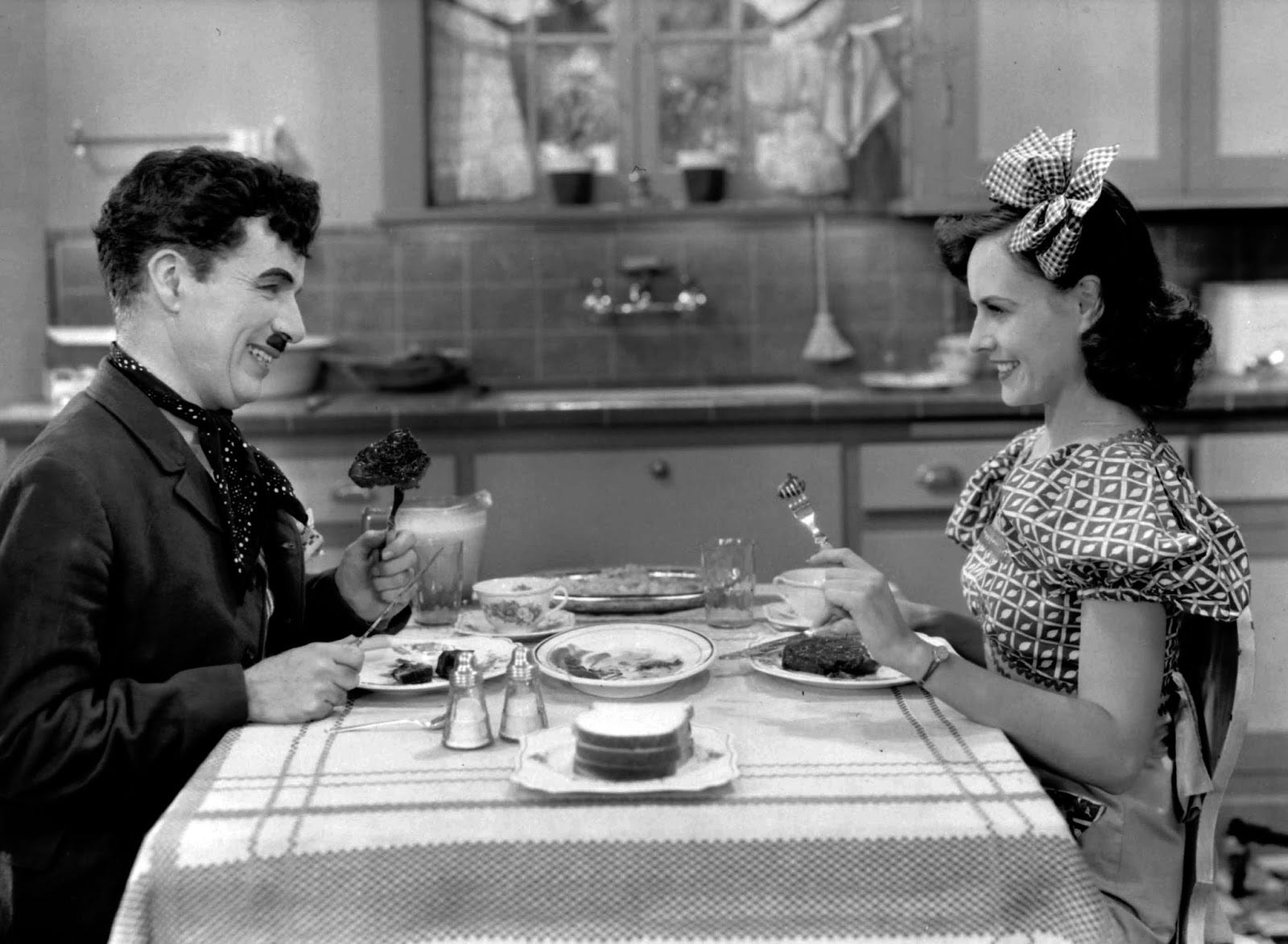
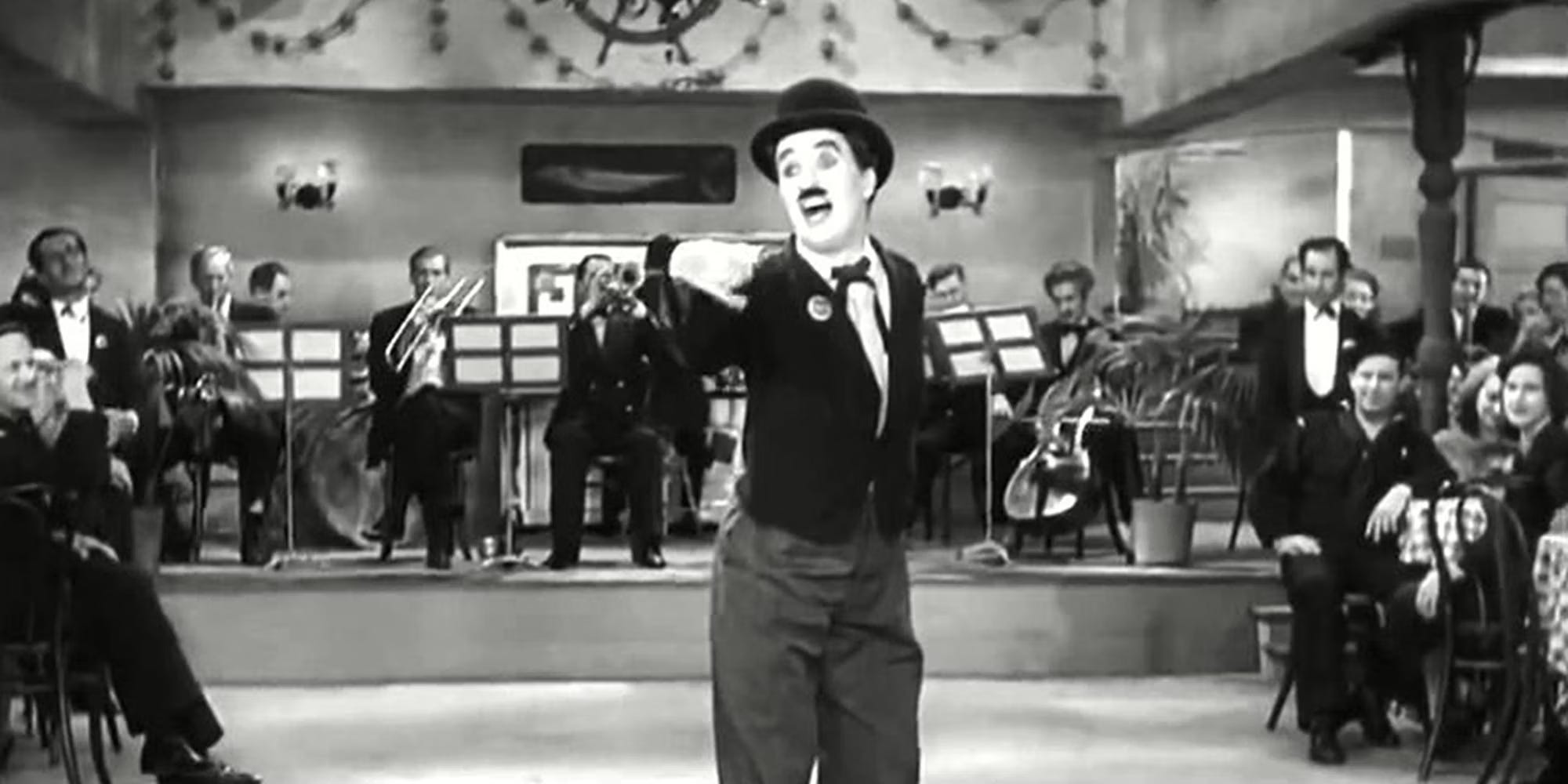
Premise: The Tramp (Charlie Chaplin) begins the film working the assembly line in a mammoth factory. The stress of the job, as depicted through some elaborate comic set pieces, pushes him toward a mental breakdown. Jailed after he’s mistaken for the leader of a communist protest, The Tramp is released from jail after thwarting a breakout. But, back on the street, he finds employment hard to come by, though he’s newly motivated after befriending a spirited gamine (Paulette Goddard), who becomes his partner. More mishaps in employment and economic distress follow, including a stint as a department store’s night watchman and a singing waiter.

Keith: Speaking broadly, most of the films on the Sight and Sound list belong to the height of the sort of film they represent. Looking back at what we’ve covered already, Once Upon a Time in the West comes from the peak of the spaghetti western. Ugetsu Monogatari comes from the blossoming of Japanese films in the years after World War II. Etc. That can’t be said of Modern Times, a (mostly) silent film made almost a decade after the premiere of The Jazz Singer. But a lot had happened in those nine years, and it’s a testament to Charlie Chaplin’s stardom that he was able to continue working as he always had, making silent comedies even after his contemporaries had either transitioned to sound (with varying degrees of success) or called it a day. There’s an autumnal sense not far beneath the surface of Modern Times. Chaplin had considered making it a full-on talkie. Instead, the film finds him attempting silent comedy on a scale he’d never tried before, as if realizing he might never get a chance to do it again.

Chaplin hadn’t released a feature in five years, most recently City Lights in 1931 (which we’ll be arriving at later). But he’d remained a celebrity and Modern Times is informed in part by world travels in which he’d met everyone from Winston Churchill to Mahatma Gandhi to Henry Ford. Both Gandhi’s criticism of technological advances and Ford, who’d done more than anyone to escalate the rate of production in the 20th century, informed Modern Times. The film’s filled with jokes and gags but the title’s not one of them. This is Chaplin making A Statement.

But what kind of statement? Chaplin’s politics leaned left, which led to a shameful exile from America years later. But Modern Times keeps the political personal. We never stray from the plight of The Tramp and, a bit later, The Gamine. It’s a film about two have-nots and their bumpy ride through some of the toughest years of the 20th century, economically speaking. The Tramp has always been an exceptional figure in Chaplin’s movies, announcing himself as a misfit from the moment he toddles into the frame. But he’s also been a stand-in for the Everyman, never more than here.

Yet for all that, I think this is also one of Chaplin’s funniest films, great from start to finish but never better than in its opening scenes, in which The Tramp’s attempts to work on an assembly line cascade into chaos. It’s as graceful a marriage of comedy and commentary as I’ve ever seen. Scott, what are your overall thoughts on the film? And I want to go deeper into individual bits, but let’s talk first about the opening stretch I’ve already mentioned, which takes place in a dehumanizing environment not that far removed from Fritz Lang’s Metropolis (also ahead on the list). It immediately announces that Modern Times has more than laughs on its mind, doesn’t it?

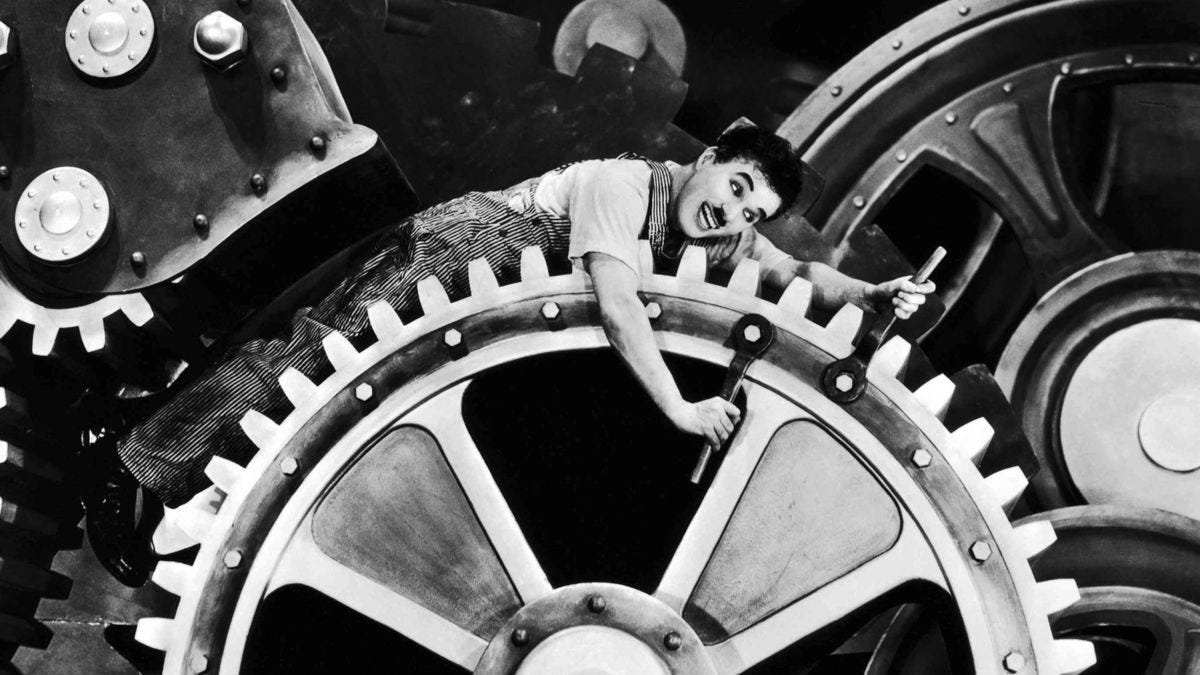
Scott: Oh, without question. From the opening shots, which juxtapose a herding of sheep with the masses of human workers emerging from a subway station, Chaplin announces the film as a statement on the industrial age, which strips mankind of its humanity before depositing them penniless on the street. I don’t think Modern Times gets any better than this first section, in which The Tramp is logging time as an assembly line drone in a factory that has no discernable product. It’s a masterstroke both in conception and production design to construct this massive factory that exists entirely in the abstract—all pulleys and wheels and giant gears, in the Metropolis mode, supervised by an all-seeing CEO and operated by laborers who are often pitted against each other.

For The Tramp, the job is to tighten two bolts on the assembly line with a wrench in each hand. We never see how this small piece of work might figure into a larger construction, only that those bolts must be tightened efficiently, especially as the big boss keeps ordering the line to go faster and faster. This brilliant comic sequence seems to have inspired one of I Love Lucy’s most famous bits, when Lucy and Ethel get a job at the chocolate factory and struggle to keep up. But Chaplin takes it further by giving The Tramp a sort of repetitive stress disorder where his wrenching arms keep moving around even when he’s not on the line. And if he does happen to have those wrenches still in his hands, he seeks to tighten anything that looks like a bolt—the buttons on a lady’s skirt, for example, or a co-worker’s nipples. It’s unmissable as commentary, but still scores big time as comedy.

Meanwhile, the decisions at this factory are being made by a CEO who’s shown reading the funny papers and monitoring his work staff through multiple cameras and screens, including one in the bathroom, where he yells at The Tramp to stop slacking and get back to the line. As you note, cinema was well into the sound era when Modern Times was produced, and it’s certainly notable to see where Chaplin takes advantage of sound in an otherwise silent comedy. Put simply here: The boss has a voice and his workers do not. He barks orders like “Section Five, more speed!” from his office and a beefy, shirtless level-puller out of Metropolis makes it happen, leaving The Tramp and others to suffer in silence.

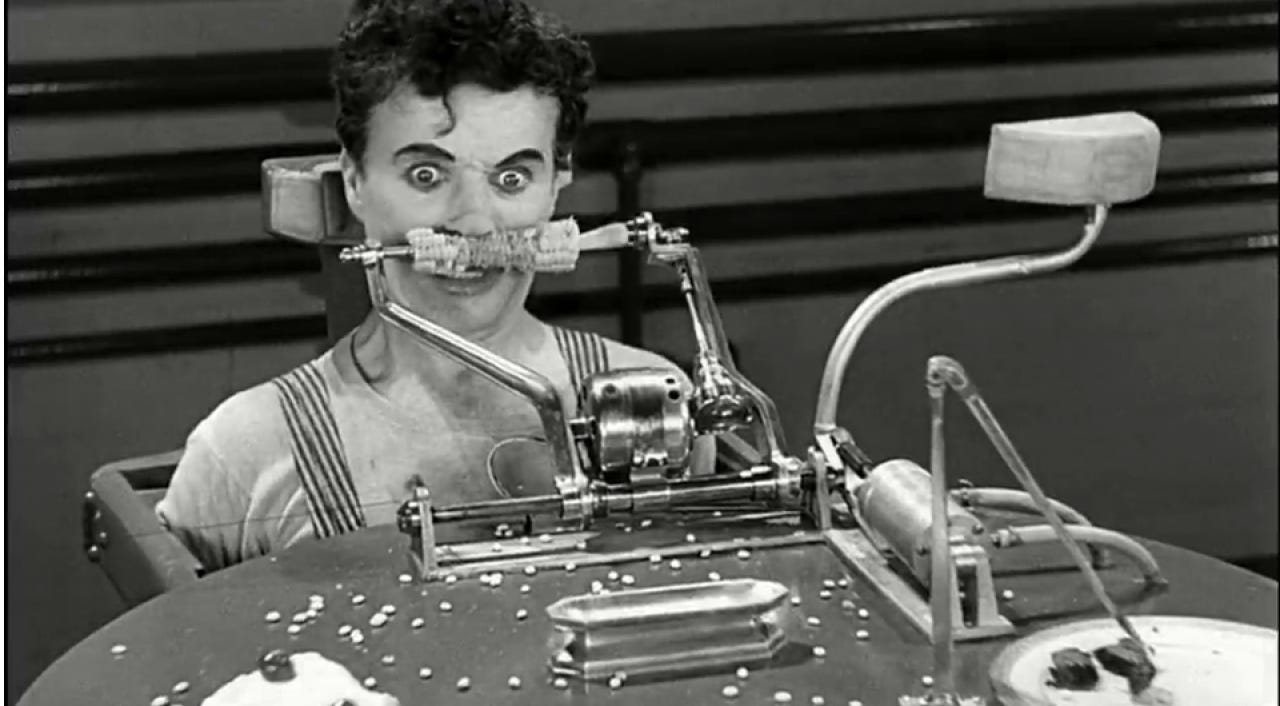
The opening section also has one of the film’s funniest bits, as “The Mechanical Salesman,” Mr. J. Willicombe Billows, introduces the Billows Feeding Machine, which will allow workers to continue to be productive when they’re on their lunch break. It’s a slight disappointment, frankly, that we don’t see The Tramp having to work the wrenches while being force-fed his lunch, but it’s still incredibly funny to see this malfunctioning gizmo splash soup in his face and assault his teeth with the “double knee-action corn feeder.” I wrote earlier about the Modern Times influence on I Love Lucy, and here you see the origins of a film like Jacques Tati’s Mon Oncle, which features a wholly automated house that’s constantly backfiring on our hero.

As social commentary, it’s hard to miss Chaplin’s intent when The Tramp slides into one of the great factory machines and literally gets grinded up in the gears of capitalism. Though The Tramp gets arrested later for inadvertently leading a communist protest, the role and rights of the common worker are central to the politics of Modern Times, which frames The Great Depression as a broken promise made to ordinary people who took this grim industrial labor and were deposited without anything to show for it. Granted, The Tramp isn’t winning any Employee of the Month plaques, but to see him kicked around from job to job (and from jail stint to jail stint) underlines the hand-to-mouth instability of the system.

Does Modern Times get any better than this first section, Keith? I’m not sure that it does, but there’s so much here to treasure, including Paulette Goddard as The Gamine. What do you make of her contribution to the film? And of the life she and The Tramp imagine for themselves?

Keith: I like Goddard a lot in the movie, though Chaplin’s camera loves her so much it takes an imaginative leap to think of her as a street urchin. That’s not to undersell Goddard’s comic talents or what The Gamine’s indomitable spirit brings to the film. It’s The Gamine that kicks off one of my favorite sequences in the film, the one you reference above: the fantasy of settling down into a nice, prosperous life, complete with a cow who wanders by to offer milk. I love it both for the snapshot it offers of the American Dream circa 1936 and for what it says about these characters, who are so far removed from the life they’re imagining for themselves that they can’t quite get the details right.

For some of the same time-traveling reasons I love their vision of bungalow life, I appreciate the sequence set in a department store. We’ll get to the inspired comic moments in a second, but I enjoy staring at the shelves and displays to see what’s on offer (which includes a stuffed Mickey Mouse that gets a quick moment in the spotlight). OK, as for the comedy, the roller-skating on the edge of the ledge is a highlight. It also makes my heart catch in my throat every time, even though I know Chaplin was never in danger while filming it. The robbery scene also provides one of Modern Times’ most memorable and thematically on-point moments. When one of would-be thieves recognizes The Tramp, he tells him, “We ain’t burglars — we’re hungry.” It’s a thin line that separates one from the other, as many learned directly during the Great Depression.

Wanting to get a sense of the environment in which this film was released, I dug up an old article from gossip columnist Sidney Skolsky, written before the film’s release, and before Skolksy had seen it, headlined “In Defense of Chaplin.” Some choice quotes:

“There are many who believe that Charlie Chaplin is dated, and they expect the flicker, ironically titled, Modern Times, to prove it. It is five years since Chaplin released a picture; during that time there hasn’t been one silent feature. [...] Today a silent flicker is a relic, the method of acting for them is considered obsolete [...] A new generation has grown up that does not know the Chaplin of the screen. They may wonder if their fathers were too hasty in proclaiming Chaplin a genius.”

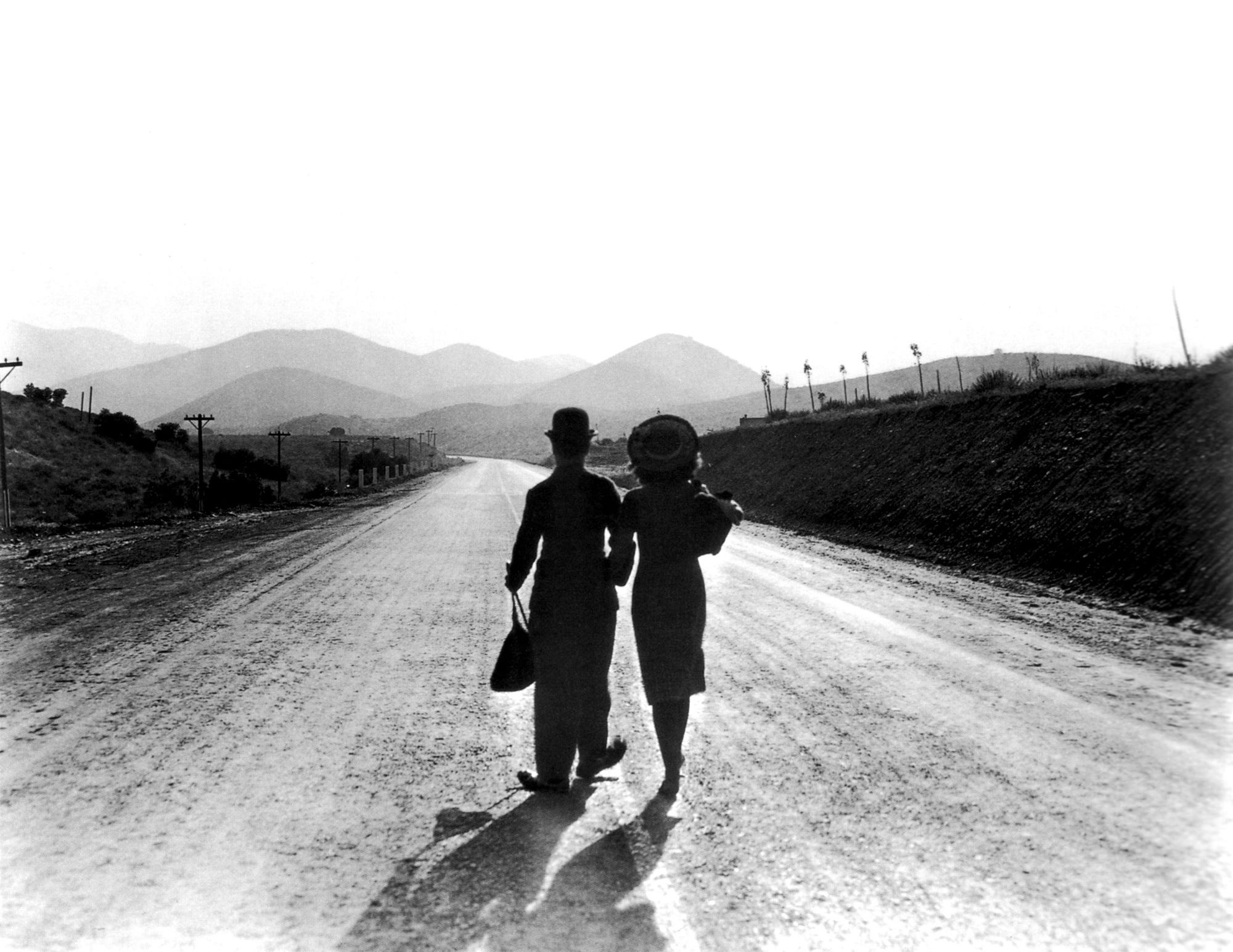
Parts of Modern Times find Chaplin nodding to contemporary tastes. The soundtrack features sound effects throughout and though we never hear The Tramp speak, we do hear him sing a nonsense song while working as a waiter. The film would become a critical and commercial success, but this would be the end of the line for Chaplin as a silent filmmaker, and for The Tramp (as much as Chaplin’s character in The Great Dictator resembles The Tramp, enough differences set them apart to make them distinct). I wonder if audiences of the time saw reminders of what had been lost with the end of the silents? The way Chaplin mimes The Tramp’s surprise and delight after accidentally getting high on cocaine, for instance, needs no dialogue, nor does the final scene of The Tramp and The Gamine walking into the sunset.

Scott, what did you think of the film’s use of sound, particularly the song? Chaplin otherwise makes no concessions to the taste of the times, using intertitles, shooting at 18fps, and using a lot of long takes. And what do you make of the ending and how it connects to all the social commentary that precedes it?

Scott: If Chaplin had really wanted to dig in his heels, then Modern Times might have been wholly silent, as if it were made during the era where sound was not technically possible. That’s not the case, obviously, so Chaplin’s selective use of sound becomes a creative weapon, akin to techniques like a great filmmaker’s use of on- and off-screen space. He may use intertitles and shoot at a lower frame rate, but you do sit up in your chair a bit when he deploys sound because it’s unexpected and pointed.

I already mentioned how you can hear the factory boss speak in the opening section, barking orders through various screens to increase production and keep his workers from spending too much time off the clock. It’s a simple expression of the factory hierarchy: The boss gets to speak and his employees don’t have the power. To extend the point even further, it seems notable that Chaplin emphasizes the sound effects on the machines, too, that take precedence over the men who operate them. Technology was as much a threat then as it would become when automation would take people’s jobs in the future. (The bolt-turning that The Tramp has to do all day is a repetitive task that’s better suited to machines and I think Chaplin makes us aware of that.)

The nonsense song that Chaplin sings at the end, “’Titine, Je cherche a Titine,” has a huge impact for a lot of reasons, not least because we’ve seen The Tramp fail in every job situation and he improvises his way into a success here. But mostly, this is his “Garbo laughs” moment, when an audience conditioned to never hearing Chaplin’s voice can be surprised and delighted by it. It’s also Chaplin re-introducing himself to a new era, despite his obstinance in making a silent comedy when everyone else had been making talkies for years. It’s ironic and absolutely charming that what he’s saying in the song is total gibberish, but the sequence reveals a confidence that he can make a leap that plenty of silent-movie stars couldn’t manage.

Much of Modern Times strings together setpieces that are sometimes barely related to “modern times,” other than referencing the hardships of the Great Depression. What makes it cohere for me is that most of the sequences end with The Tramp getting arrested and going to jail, which provides him a security that he prefers to the uncertainty of a dried-up labor market and a roof over his head. When The Gamine dashes off with a loaf of bread from a bakery, it’s only half-heroic when he steps up and volunteers to take the rap for her. He’s more comfortable when he’s not botching odd jobs on the outside.

Do you have a favorite sequence of The Tramp at work? The obvious standout candidate is the security gig at the department store, which is great for all the reasons you mention, between the fantasy of living it up on every floor (shades of future films, like Dawn of the Dead, making a utopia out of an empty mall) to the skating sequence to the revelation that the burglars are really in the same boat as everyone else. I also like the gag on the dock construction site where The Tramp pulls a wedge and a half-built ship drifts off into the sea. But my vote is for The Tramp returning to factory work with a gig as a mechanic’s assistant, which calls back to the beginning of the film. He knocks into levers, crushes a family heirloom, spills a toolbox into the gears of a machine that spits the tools right back out, and then gets the mechanic himself so squeezed in the works that he has to feed him lunch upside down. Now The Tramp is the Billows Feeding Machine, jamming a celery stalk and egg into the man’s mouth, along with custard pie and hot coffee. An inspired bit of madness.

And yet, Modern Times isn’t a despairing film in the end, which speaks to Chaplin’s sentimental streak perhaps, but also his belief in the redemptive powers of love and the human spirit. The end finds The Tramp and The Gamine in what would seem to be their lowest moment, reduced to hitchhiking on the side of the road with their few possessions wrapped up like hobos. She asks, “What’s the use of trying?” and he’s defiant, saying “Buck up. Never say die. We’ll get along.” In the gorgeous last shot, they’re heading down the road of life together with a smile on their faces. They have each other and that’s a start.

Any final thoughts from you, Keith? It seems like the excitement over Buster Keaton’s work in recent years—and by “recent years,” I’m thinking all the way back to the Kino VHS box that blew many people’s minds (including my own) decades ago—has come at the expense of Chaplin’s reputation. Are we underrating Chaplin now?

Keith: On the subject of favorite bits of work business, I’m not sure you left much for me! So I’ll just throw in a bit of trivia about the film originally including a scene in which The Tramp enlisted in the army and went to war. But because Chaplin exercised such tight control of his films, destroying virtually all unused footage, we’ll never see that, or the alternate ending in which The Gamine becomes a nun.

As for underrating Chaplin, that’s a tough question. I feel like Chaplin has been judged “too sentimental” and compared unfavorably to Keaton for as long as I’ve been reading about movies. I just don’t see it, honestly. I won’t argue that he made sentimental movies, it’s the “too” that trips me up. I’m also not sure that Chaplin was well-served in terms of home media and availability over the years. The first Chaplin I saw was a public domain VHS tape of The Gold Rush, which I loved but wasn’t exactly the best introduction. Criterion’s been doing a pretty good job with the features and, on the Criterion Channel at least, the Mutual shorts, which features the best of his pre-features career. I’ve loved him since first seeing The Gold Rush and I’m happy to see what I think are his two best films made the Sight & Sound 100, just as they did in 2012 and 2002. But they’re the only two in the top 250 and The Gold Rush also made the top 100 in 1992. But I guess, on the whole, Chaplin’s stock remains more or less unchanged over the past few decades, at least on this poll. The Tramp stays in the picture.

Wednesday, February 5, 2025

TERMINATOR 2


Although the first act is somewhat constricted by hardwaring of the story arteries, chunks and bursts of raw, quirky human behavior ultimately burst into this carnage colossus. These small, funny, odd moments do much to soothe us from the bombast, as well as clue us to the film’s ultimately optimistic vision.

Still, the bulk of Terminator 2 is the war between the two Terminators, and Cameron and his ace crew have marshaled all the forces of special effects technology, as well as motorcycle maintenance, to accomplish this staggering one-on-one blowout.

Throughout, state-of-the-art technical contributions thunder like explosions. Adam Greenberg’s torrid cinematography; Conrad Buff, Mark Goldblatt and Richard A. Harris’ kinetic cuts; Joseph Nemec III’s visionary production design; together with Brad Fiedel’s heart-pounding score and Gary Rydstrom’s percussive sound design infuse Terminator 2 with a power and force a quantum leap beyond its generic peers.

The players, astoundingly, more than hold their own against this torrential visual/aural onslaught. Schwarzenegger is not only back, but he’s more imposing and heroic than ever. His comic sense, once again, is one of the strongest parts of his arsenal and often helps to save the action from its massive musculature. Furlong’s nervy performance as the nervy 12-year-old savior catapults the story to its fullest human dimension, while Hamilton is superb as his gutsy mother.

IT HAPPENED ONE NIGHT 1934


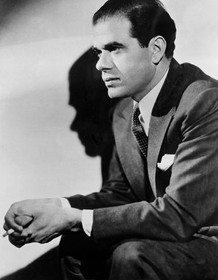
When It Happened One Night (1934) was released, both director Frank Capra and screenwriter Robert Riskin were ascending in Hollywood but had not yet reached their peak.
Capra had been directing for Columbia Pictures throughout the late 1920s—He directed two Harry Langdon comedies--and in the early 1930s, fast moving talkies like Manhattan Madness (1930), Ladies of Leisure (1932) and Lady for a Day (1933), helping elevate the studio from a Poverty Row outfit to a major player.

It Happened One Night, based on a short story called "Night Bus" by Samuel Hopkins Adams, faced a difficult start, with actor after actor rejecting the lead roles. Eventually Claudette Colbert took on the role of Ellie and Clark Gable was loaned from MGM to play Peter. Despite the initial reaction--it opened to only so-so reviews, the film performed well in smaller towns and ended up winning every Oscar for which it was nominated, including Best Picture, Best Actor, Best Actress, Best Director, and Best Writing (Adaptation), marking the first time in history that one film swept the top five Oscar categories.

"It’s the story of a salty, hooch-swilling reporter (Clark Gable) who is thrown together with a spoiled society heiress (Claudette Colbert) on an overnight Greyhound bus to New York. The film simply follows them as they bicker, backbite and clamor for the upper hand. Every line of dialogue is calculated bliss, the chemistry between the leads is magnificent, and the backdrop of Depression-era America allows for a prescient and amusing subplot about how well-heeled urbanites are compelled to misbehave when they have no money in their designer pockets. It’s probably more historically important than it is a masterpiece (the last 20 minutes take the missed connections and misunderstandings an inch too far), but it’s still very easy to fall in love with.." - David Jenkins, Time Out
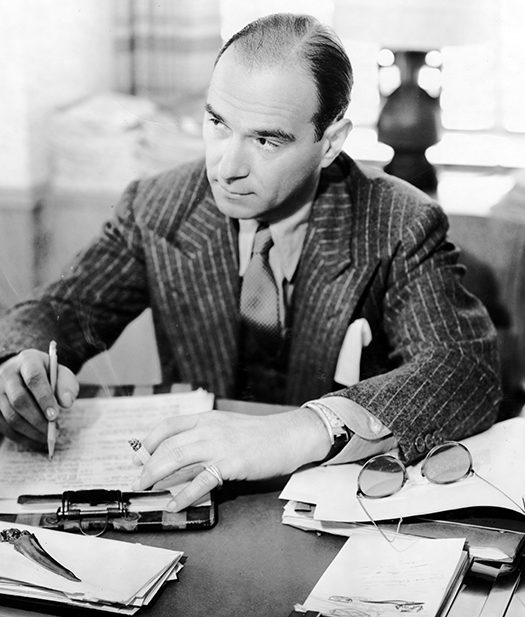
Robert Riskin, a skilled playwright-turned-screenwriter, had been working in Hollywood since the late 1920s. His partnership with Capra resulted in some of the era’s most memorable films, often blending witty, fast-paced dialogue with socially conscious themes. His writing was central to shaping Capra’s trademark blend of humor, romance, and idealism.
Photo by George Hurrell.
Clark Gable (1901–1960) was a Hollywood icon, known as the "King of Hollywood" for his commanding screen presence and rugged charm. He was named the seventh greatest male movie star of classic American cinema by the American Film Institute.

Gable's stepmother raised the tall, shy child with a loud voice to be well-dressed and well-groomed. She played the piano and gave him lessons at home. He loved to repair cars with his father, who insisted that he engage in masculine activities such as hunting. But he also loved literature; he would recite Shakespeare among trusted company, particularly the sonnets.

Gable appeared in over 70 feature films and first began acting in stage productions, before his film debut in 1924. Gable's acting coach, Josephine Dillon, was a theater manager in Portland. She paid to have his teeth fixed and his hair styled. She guided him in building up his chronically undernourished body, and taught him better body control and posture. He slowly managed to lower his naturally high-pitched voice, his speech habits improved, and his facial expressions became more natural and convincing. Dillon became his manager and also his wife; she was 17 years his senior. They moved to New York City, where Dillon found work for him on the stage.

After many minor roles, Gable landed a leading role in 1931. Joan Crawford asked for him to appear with her in Dance, Fools, Dance (1931). The electricity of the pair (and resultant affair; he divorced Dillon.) was recognized by studio executive Louis B. Mayer, who put them in seven more films. Subsequently he would become one of the most consistent box-office performers in the history of Hollywood, appearing on Quigley Publishing's annual Top Ten Money Making Stars Poll sixteen times.

He often acted alongside re-occurring leading ladies: seven movies with Myrna Loy, six films with Jean Harlow. Gable's "unshaven love-making" with braless Jean Harlow in Red Dust made him MGM's most important romantic leading man.

His film persona often depicted strong, confident men with a roguish appeal. Gable’s most famous role was Rhett Butler in Gone with the Wind (1939. Other major films include It Happened One Night (1934), for which he won an Academy Award for Best Actor, Mutiny on the Bounty (1935), San Francisco (1936), Test Pilot (1938)), The Hucksters (1947), Mogambo (1952) and The Misfits (1961), his final film.

Beyond his on-screen success, Gable led a fascinating personal life. He was married five times, with his third wife, actress Carole Lombard, being the love of his life. Her tragic death in a plane crash deeply affected him. He also had a daughter, Judy Lewis, with actress Loretta Young, though this remained a secret for many years. During World War II, Gable enlisted in the U.S. Army Air Forces, flying combat missions and earning military honors.

Claudette Colbert (1903–1996) was a French-American actress known for her wit, charm, and versatility. Born Émilie Claudette Chauchoin in Saint-Mandé, France, she moved to New York as a child. Initially aspiring to be a fashion designer, she shifted to acting while studying at the Art Students League.

Colbert's Hollywood career took off in the 1930s, making her one of the most bankable stars of the Golden Age. She won the Academy Award for It Happened One Night (1934), a landmark screwball comedy. Other notable films include Cleopatra (1934), Midnight (1939), and The Palm Beach Story (1942). She received additional Oscar nominations for Private Worlds (1935) and Since You Went Away (1944).

Known for her sophisticated wit, charm, and relatable screen persona, Colbert had a keen sense of comedic and dramatic timing.. Off-screen, she was private, maintaining a long marriage to Dr. Joel Pressman. In later years, she transitioned to television and stage, earning a Tony nomination in 1959. She spent her final years in Barbados, passing away at 92. Today, she is remembered as one of Hollywood’s most enduring and stylish leading ladies.

Tuesday, February 4, 2025


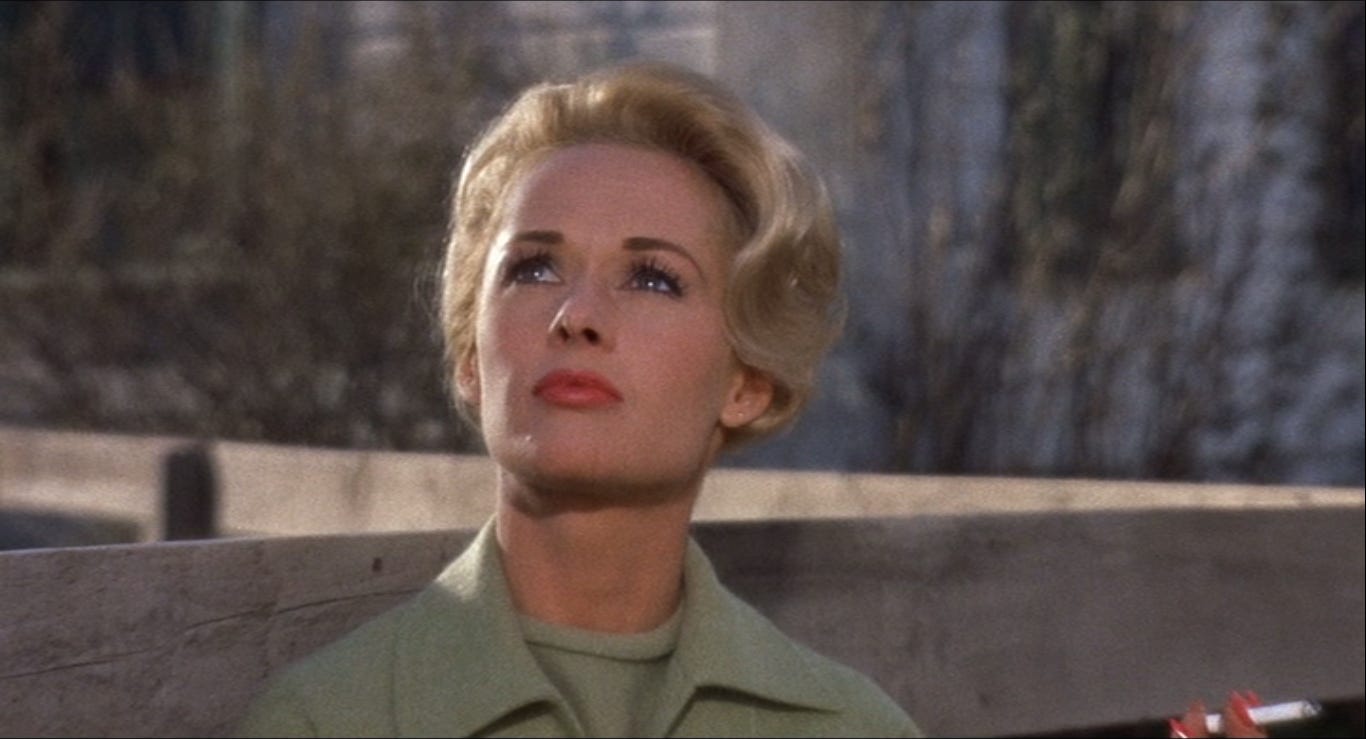
10 Thoughts on Alfred Hitchcock's 'The Birds'

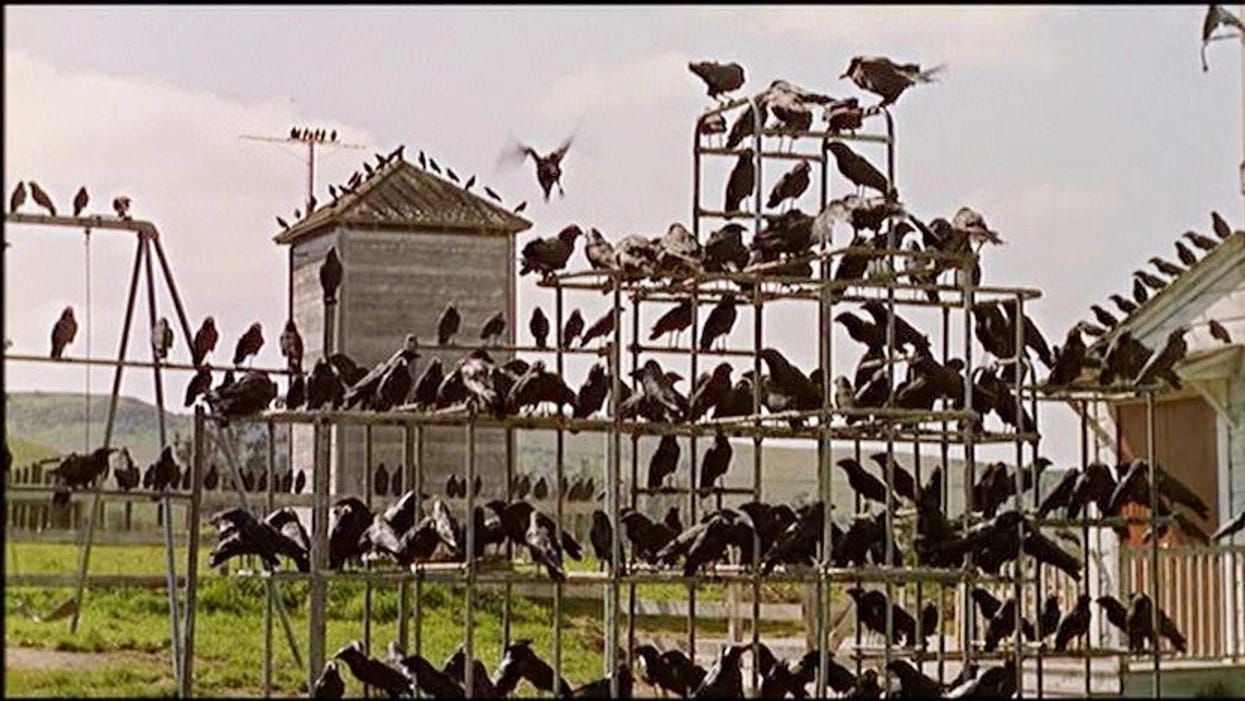
In 1963, Hitchcock followed the mammoth success of ‘Psycho’ with an elusive, unsettling film unlike anything else he’d ever make.

By the 1960s, Alfred Hitchcock had become the most famous movie director in the world. Via cameos, a much-watched television program, humorous trailers, and books and magazines bearing his name and image, he’d become a kind of brand name. Brands create expectations. For The Birds, his 1963 follow-up to the massive success of the 1960 thriller shocker Psycho, he embraced some while discarding others.

1. It’s not the film I thought it was.

It’s very possible this is just me, but I’d come to regard The Birds as one of the more minor of Alfred Hitchcock’s major movies. I had not seen it since college until rewatching it recently and I remembered it as an excellent film that nonetheless didn’t play to Hitchcock’s strengths. It’s more monster movie than suspense film. It offered little of the psychological complexity of Hitchcock’s other films. Tippi Hedren was no Kim Novak. Rod Taylor was no Cary Grant (well, that was fair). Wasn’t the opening kind of slow? Was there really any even subtext?

Boy did I get it wrong.

2. The opening credits sequence a mini-masterpiece onto itself.

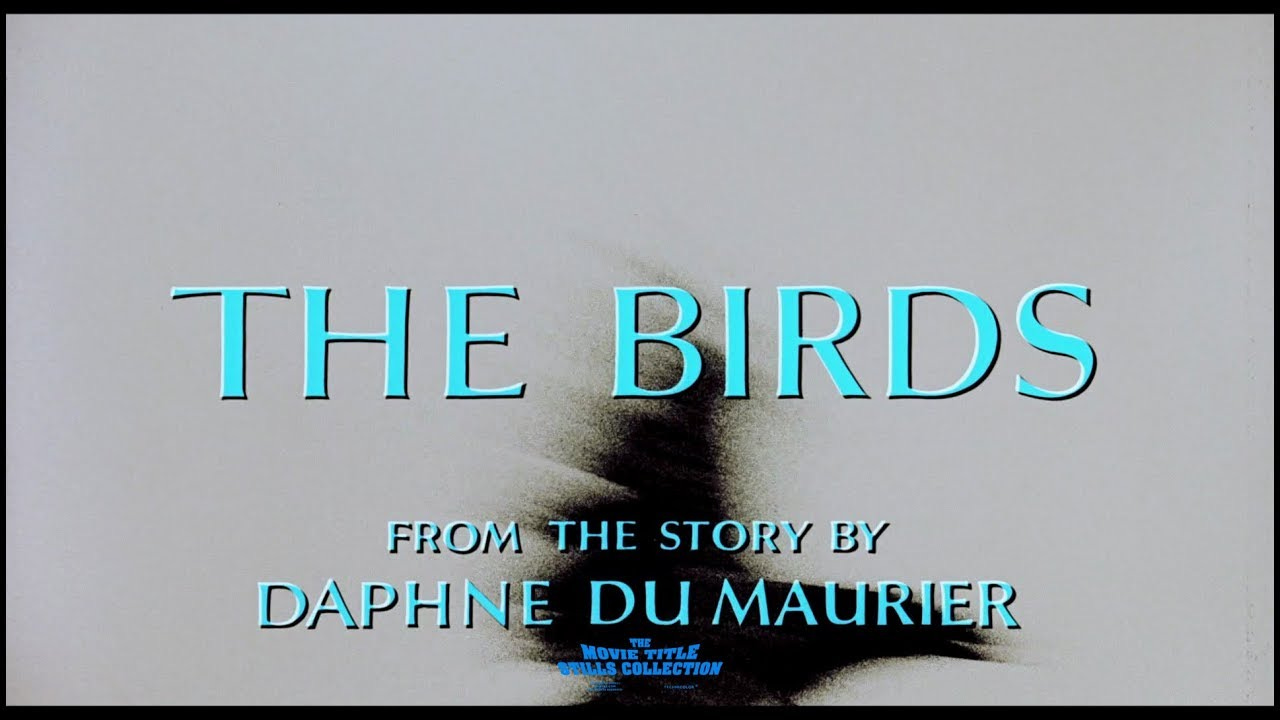
The silhouettes of birds flap frantically across a soft gray backdrop, accompanied by the sound of flapping wings, chirps and caws. I’m not sure how this was created. It appears to be images of real birds, but their movements are almost entirely on a two-dimensional plane, as if flying back and forth behind glass in a narrow space. It’s hard to find much information about titles designer James S. Pollak. He has credits on just one other film, The Wheeler Dealers (released, like The Birds, in 1963), though he apparently did uncredited work on the Grand Prix titles a few years later. Is he the same James S. Pollak who wrote the 1946 novel The Golden Egg, a satire of Hollywood? Maybe. Pollak would have been 37 at the time. He could have been a journeyman figure who wandered into creating titles for a few years then wandered out. Whichever the case, this a haunting and strange way to start the movie, made all the more unsettling by the cyan text and titles that fall together in pieces then fall apart just as quickly. In some ways, that process is just as apt a way to open this movie as the birds themselves.

3. What kind of film are we watching?

In the short Blu-ray documentary “Hitchcock’s Monster Movie,” horror scholar David J. Skal posits that, while not a monster movie itself, The Birds would not exist were it not for the giant monster movies of the 1950s. The formula, codified by films like The Beast from 20,000 FathomsThem!, Godzilla and others, involved beasts running amok and threatening civilization, usually as a result of science pushing nature too far. But is that really what’s going on here? Nature pushing back is posited as one explanation for the bird attacks, but not necessarily the most plausible reason in a film that never explains or resolves its central mystery. (More on that in a bit.) It’s another quote, this one in the feature-length doc All About the Birds, that unlocked something for me. Screenwriter Evan Hunter (probably now best known for the crime fiction he wrote under the name “Ed McBain”) claims he came on board after being told Hitchcock would be throwing out “everything but the title” of the Daphne du Maurier novella The Birds adapts and suggested beginning the film like a screwball comedy. *

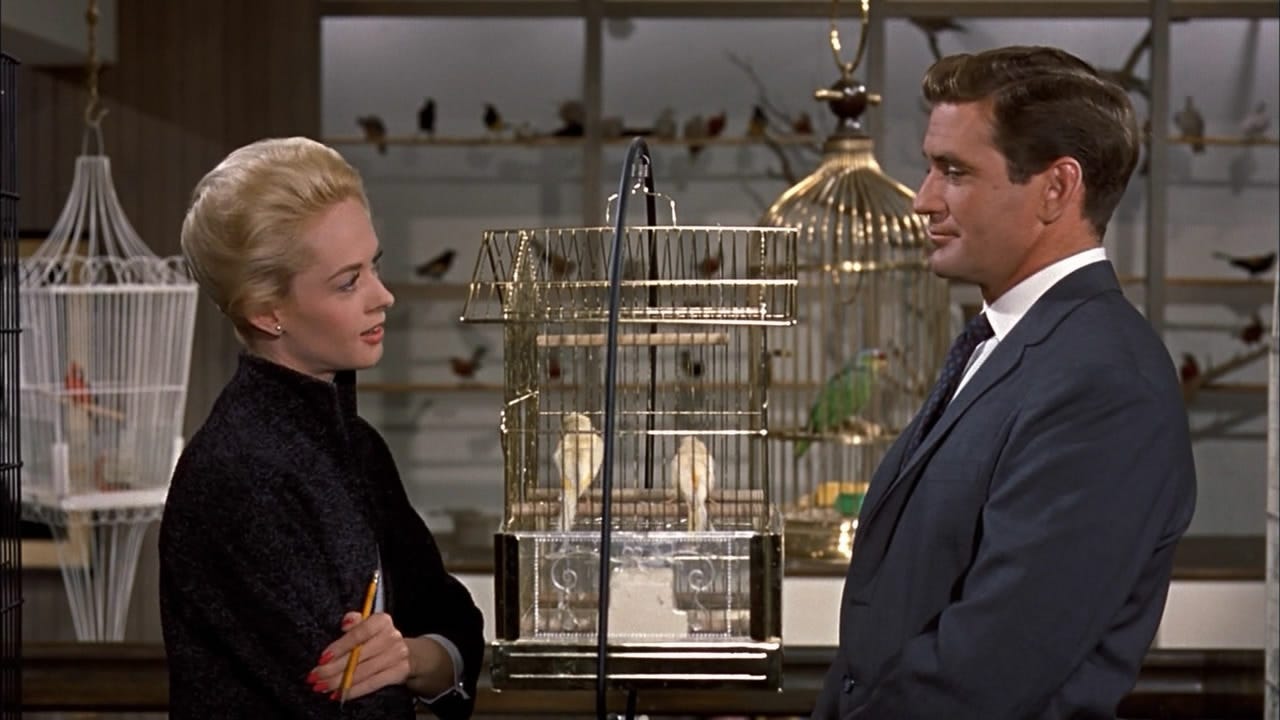
I’d never thought about it this way, but of course this is what’s going on in the film’s long lead-up to the first bird attack, a gull plunging at Hedren’s skull as she makes her way across Bodega Bay by boat. Hedren plays Melanie, the spoiled daughter of the publisher of a San Francisco newspaper. She has a meet-cute with Mitch (Taylor) in a pet store after Mitch recognizes her then plays along as she pretends to be an employee of the store, a mild example of the pranks that made her a semi-notorious figure. They bicker when she realizes he’s having her on and plots a kind of revenge by delivering the pair of lovebirds he was attempting to buy for his much younger sister Cathy (Veronica Cartwright). When told Mitch has left to spend the weekend at his family home in Bodega Bay, she follows him there.

It’s all classic screwball material. Melanie’s fur coat marks her as a high society outsider in the salt-of-the-earth community of Bodega Bay. She banters with Annie (Susanne Pleshette), a rival for Mitch’s affections. Yet it feels increasingly unsettling the longer it plays out. On page, it’s light comedy, but Hitchcock directs like, well, an Alfred Hitchcock film. When Melanie sneaks into Mitch’s family home while he’s out, everything about the scene suggests something horrible is about to happen. Then, when something horrible finally does happen, everything screwball goes out the window.

It’s incredibly spooky for reasons that are hard to pin down, a daring exercise in not giving the audience what they expect and repackaging the familiar in the form of the “wrong” genre. And yet, neither Hitchcock nor Hunter seems to have seen it this way. “Like all pictures of this nature, its personality didn't carry,” Hitchcock told Cinefantastique in a making-of article published in 1980. "If the picture [he always said ‘picture,’ never ‘film’] seems less powerful today than it did in 1963, that's the main reason, that the personal story was weak. But don't tell that to Evan Hunter.” 

He went on to call Hunter not “the ideal screenwriter,” prompting a defensive response from Hunter in the same article (in which he also laments the presence of scenes written by an unknown hand): 

“If there were weaknesses in my screenplay […] they should have been pointed out to me before shooting began, and they would have been corrected. I feel the weaknesses were manifold, but only some of them were in the script. The concept of the film was to turn a light love story into a story of blind, unreasoning hatred. Since Hedren and Taylor could not handle the comedy at the top of the film, the audience became bored. They had come to see birds attacking people, so what was all this nonsense with these two people, one who can't act and the other who's so full of machismo you expect him to have a steer thrown over his shoulder? Bad acting and — for Hitchcock — incredibly bad directing.”

The film, however, suggests both were wrong. Something about what we see feels off even before the birds begin attacking. When they do, it plays less like a shock than a confirmation that something is terribly wrong with what we’re watching.

4. The sound of no music…

Hitchcock had a long partnership with composer Bernard Herrmann, who’s credited as a “sound consultant” here. But The Birds has no score, just an eerie absence that contributes to the airlessness of the screwball material that opens the film and makes every scene unbalanced and uneasy. Score music, particularly powerful, direct work like Herrmann’s, suggests how we should feel. The Birds offers no such guiding hand, which ends up making tense exchanges between characters feel heightened and the bird attacks more immediate.

5. …but not the sound of silence

Instead it’s bird noises that fill the sonic void. Well, not exactly bird noises. Hitchcock turned to Oskar Sala and Remi Gassmann to create bird effects using an early electronic synthesizer called the Trautonium. And by “early,” I mean decades for The Birds. The work of German engineer Friedrich Trautwein, the Trautonium was then refined by Sala, who continued to work with the instrument until his death until 2002. It’s an odd instrument, a kind of keyboard without keys that creates tones that fall somewhere between the sounds created by a Theremin and a Moog. It can be quite beautiful, in the right hands. Sala wasn’t interested in creating beautiful noises, however, crafting instead a bed of not-quite-nature cries and caws that contribute to the film’s unnerving effect. (There’s a short news item about Sala’s work on The Birds on YouTube. It’s in German. Yyou can turn the subtitles on.)

6. Natural’s not in it.

Bird noises that resemble but don’t exactly match bird noises we know fit perfectly into the design of the film. The film uses real birds but also dummies and visual effects. Some of the latter is the work of Ub Iwerks, the animator now credited as Mickey Mouse’s co-creator. Iwerks was nearing the end of his long second stint at Disney, while also working for other studios. One of his innovations was the sodium vapor process, which improved on bluescreen effects.

Improvement doesn’t mean perfection. The seams show in The Birds’ Oscar-nominated effects. But they also seem true both to the not-quite-natural sounds the birds make as well as the off-reality world of the film. Hitchcock disliked shooting on location, and though The Birds contains quite a few location scenes, it mixes them with those shot in the studio, sometimes against sweeping matte paintings. They’re not fully convincing, but they don’t have to be, just as the frictionless rear-projection driving scenes don’t have to look exactly right. I much prefer the stylized reality of these touches to many contemporary greenscreen effects that miss realism by a couple of inches and end up swallowed by the uncanny valley. As longtime readers and Next Picture Show listeners know, I could go on at length about my distaste for the idea of “dated” effects. I won’t continue this train of thought any further, but I think The Birds can be Exhibit A for my argument going forward. No, the effects don’t quite feel real. Why should they? You’re watching a movie. Reality is elsewhere.

7. Blondes have only slightly more fun.

The Birds has become a topic of much conversation in the past dozen years, first due to the HBO movie The Girl, which depicts Hitchcock as behaving abusively toward Hedren after she rejected his sexual advances, and again in 2016 when Hedren made even more unsettling claims in her memoir, Tippi. Though those claims fall outside the scope of this piece, there’s no reason not to believe her and they’re now part of the history of the film and hard to put out of mind when watching it. Whatever happened off screen, The Birds is certainly another Hitchcock film built at least partly around the undoing of an icy blonde, though at least Melanie makes it out of this one alive, unlike poor Marion in Psycho or the blondes of other movies. But spare a moment for Hitchcock’s non-blondes. or at least the blondes that don’t fit the mold. Barbara Bel Geddes’ fate in Vertigo, forgotten by both the protagonist and the film at the halfway point, looks kind to what happens to Suzanne Pleshette’s Annie here.

8. Love is an uneven polygon.

Melanie desires Mitch, despite her protestations. Mitch desires Melanie, despite his own. Annie still wants Mitch, even sticking around in Bodega Bay after the end of their relationship, brought about the icy behavior of Lydia (Jessica Tandy), Mitch’s mom. (Does Tandy smile once in this movie? Something to watch on a subsequent viewing.) Lydia fears being alone and clings to Mitch after the death of her husband. When Lydia tells Mitch he’s not the man his father was, it wounds him. Annie claims the situation can’t be read psychoanalytically, “With all due respect to Oedipus.” I’m not so sure. It’s all quite tense, vague, and unsustainable, a situation bound to fall apart and crush some of those involved. The drama plays out—sometimes at a simmer, sometimes at a boil—even as the bird attacks intensify. Are the birds, as John Carpenter has suggested, “a symbol of the tensions going on between the characters?”

9. What’s happening??!?? [Insert the appropriate Poltergeist gif here] 

So, maybe the birds are a symbol of the tensions between the film’s characters. Or maybe they’re not? In one of the film’s best scenes, the customers at a Bodega Bay diner toss around options. Mrs. Bundy, a bird enthusiast (“ornithology happens to be my avocation”), can’t believe birds would attack humans but introduces the nature-in-revolt possibility anyway when she says, “It is mankind, rather, who insists upon making it difficult for life to exist upon this planet.” Or maybe, as another customer suggests, it’s the end of the world. Or maybe, as a terrified woman proposes after a subsequent attack in which all hell breaks loose, Melanie is to blame. “They say when you got here the whole thing started,” she tells the outsider, phrasing that suggests she’s not alone in this opinion. (We first see birds behaving suspiciously in San Francisco. Perhaps they followed her. Or maybe the love birds are to blame?) So which is it? Or is it none of the above? I don’t think the answer can be found in the film itself. These theories are thrown out in the midst of a busy diner against the backdrop of orders being taken. Characters talk over one another. It’s not quite a scene from a Robert Altman film, but the controlled chaos suggests a lot of ideas flying around with no firm ground upon which to land.

10. Never the end.

The first time I heard of Alfred Hitchcock was when a friend of my parents told me, in frustration, “his movies don’t have endings.” Pressed, she elaborated, “They don’t end right.” I wonder if she specifically had The Birds in mind? If so, she’s not that far off. The plan, until late in production, was to end the film with Mitch, Cathy, Lydia, and the battered Melanie making their way through a bird-filled town until they escaped Bodega Bay. Instead, it ends as it ends now, their fate unclear as they drive through a landscape filled with noisy birds who might be plotting against them and bathed in sunlight that could be on loan from a Biblical epic. And maybe Bodega Bay was just the first place to fall. Maybe there is no escape. The Universal logo that ends the film provides no answers. Originally Hitchcock didn’t even want this, but it almost feels necessary, a final reminder, as the last echoing caw fades from the soundtrack, that we’ve been watching a movie. Yet, as a punctuation mark, the logo plays more like and ellipses than a period. It’s the end, and yet…

* This is mostly true. Du Maurier’s novel depicts a similar bird uprising entirely from the perspective of a Cornish farmhand attempting to protect his family. Du Maurier’s descriptions of the birds’ attacks on the protagonist’s home, however, clearly inspired similar scenes in the film.

Leave a comm