

On the set of The Ascent
She entered the Gerasimov Institute of Cinematography (VGIK), where Andrei Tarkovsky was then still studying. The war had been permanently etched into the minds of Soviet children, who had witnessed its atrocities or lived with their effects. By the time of the cultural thaw that began after Joseph Stalin’s death in 1953, they were beginning to be able to express in film and literature what they had seen, and in this way analyze it beyond politics and psychology.
At film school, Shepitko found her mentor in Alexander Dovzhenko, a major figure of early Soviet cinema. The realist films being made throughout Europe in the postwar period provide a glimpse of a time before women had or expected much. We still stirred the batter and shook out the broom and changed the sheets by turning them over. (The last children to witness this have almost disappeared.) But Shepitko was destined for more.
From her first feature, her graduation film, Heat (1963), she was recognized and awarded. She went on to make three more feature-length films—Wings (1966), You and I (1971), and The Ascent (1977)—in addition to two student shorts, a segment of an omnibus film, and a movie for television.
Her greatest works possess a startling intimacy: Wings is the story of a former fighter pilot, once ecstatic in the air, now dulled by her return to ordinary earth as a school principal; The Ascent is a wartime parable whose stark winter landscapes throw its characters’ suffering into terrible relief. In both of these, the whiteness of snow and clouds punctuates the plight of the human figures.
The Ascent is also particularly haunting for its Christian symbolism. Religious practices that were by and large derived from the Eastern-rite Catholic Church in Ukraine lingered underground there after the churches were shut down by Stalin. The relics of Christianity still turn up, shadowy and broken, in the backgrounds of many Soviet postwar productions. You see this even in works by the most secular filmmakers, well into the eighties; Shepitko, who later in life found a spirituality that inclined toward the mystic, did not regard herself as religious.
Tall, dark, and good-looking, Shepitko married the Russian director Elem Klimov (whose Come and See, like The Ascent, ranks among the great war films) and gave birth to a son, Anton. She was continually interrupted by illness and accident—she suffered from hepatitis during the making of Heat, sometimes becoming so ill that she directed from a stretcher; and, while shooting her short The Homeland of Electricity (1967), seriously injured her spine in a fall—but did not hesitate to go to the limits with her actors and crew. She shot her last film in perilously cold weather. Shepitko had a continuing fear of death that made her both superstitious and visionary. She died at age forty-one in a car crash.
The Ascent is also particularly haunting for its Christian symbolism. Religious practices that were by and large derived from the Eastern-rite Catholic Church in Ukraine lingered underground there after the churches were shut down by Stalin. The relics of Christianity still turn up, shadowy and broken, in the backgrounds of many Soviet postwar productions. You see this even in works by the most secular filmmakers, well into the eighties; Shepitko, who later in life found a spirituality that inclined toward the mystic, did not regard herself as religious.
Tall, dark, and good-looking, Shepitko married the Russian director Elem Klimov (whose Come and See, like The Ascent, ranks among the great war films) and gave birth to a son, Anton. She was continually interrupted by illness and accident—she suffered from hepatitis during the making of Heat, sometimes becoming so ill that she directed from a stretcher; and, while shooting her short The Homeland of Electricity (1967), seriously injured her spine in a fall—but did not hesitate to go to the limits with her actors and crew. She shot her last film in perilously cold weather. Shepitko had a continuing fear of death that made her both superstitious and visionary. She died at age forty-one in a car crash.
----------

The story of The Ascent—based on the 1970 novella Sotnikov by Vasil Bykov—is a simple one: two Soviet partisans get separated from their unit; they are lost and lashed by snow and wind. The film opens in an empty white field that slowly unfolds into a cluster of soldiers, who rise to their feet, carrying their belongings with them. It is not long before the stakes of the story are established: Shots ring out like bells. The people fall and run; one turns and shoots back and hits someone as the rest climb toward the hills and woods. After this retreat, Rybak (Vladimir Gostyukhin) and Sotnikov (Boris Plotnikov) leave in search of supplies and sustenance.

The Ascent is set in Belorussia, the site of a Nazi genocide. Survival by collaboration was rife, and Nazi massacres of peasants and Jewish people frequent. Shepitko had been a child in the world where this was happening. Her movie shifts between the business of survival and another ultimate question: Why live in such a world?
The drama is about varieties of snow as much as it is about varieties of religious experience. The snow blinds you, gets in your boots, freezes your feet and hands, breaks on your lips, and slows you down. In the film, there is no straight path through it, partly because the snow has obliterated almost any signs of paths or stopping places. The sites where action occurs have either been burned to the ground or are about to be.
There is a syndrome called visual snow syndrome, in which white dots are endlessly sprinkled across a person’s field of vision—comparable to the “snow” we know on analog screens. Visual snow, all you can see, the face of Christ just as easily found in there as the shape of a tree—an afterimage that trails the snap glance, organizing it into the hollow face we know from painting and film. In a similar fashion, the viewer scours the forbidding, snowbound images of The Ascent for such signs of life and meaning. Throughout the film, there are traces of a dying Christ, of pale martyrdom, of pure nihilism. Nothing comes to save or enlighten the two soldiers. Their faces and actions are recapitulations of faces and actions that have occurred throughout history.
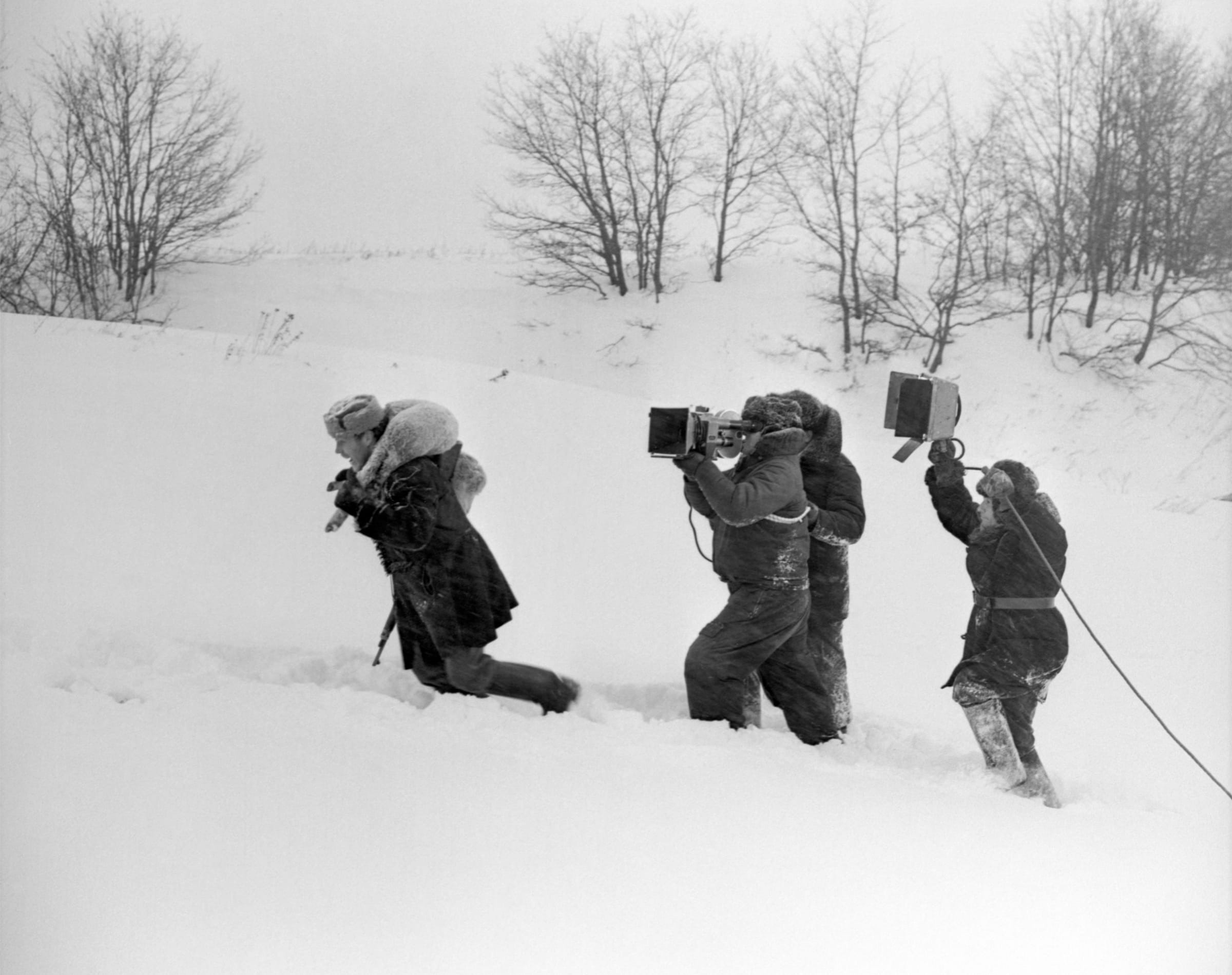
On the set of The Ascent
Shepitko was there for the iciest days on the set of The Ascent, even though she was frequently ill. It was grueling to shoot in the cold, but her cast and crew were there to accompany her in her attempt to account for the brutality that had overtaken the world in the first several years of her life. “The impression of a global calamity certainly left an indelible mark in my childhood mind,” Shepitko said.
----
the struggle down on the ground is the most ineffaceably haunting aspect of The Ascent. The sun spreads its platinum light across floor and furniture and on the awful evil of the suited man at the desk who organizes tools for torture, the shiny implements used by doctors around the world. The prisoner’s idealism and defiance only make the interrogator smile. When the prisoner asks him what he was before the war, the laugh is on the prisoner when the man all but says, I was like you.
____________________________________________________
___________
