MARK KERMODE, THE GUARDIANThe true meaning of Jaws has been picked over by critics and academics ever since its release in June 1975, and even its status as the first summer blockbuster has been questioned. But isn’t it just about a killer shark?
First things first; Jaws is not about a shark. It may have a shark in it – and indeed all over the poster, the soundtrack album, the paperback jacket and so on. It may have scared a generation of cinemagoers out of the water for fear of being bitten in half by the “teeth of the sea”. But the underlying story of Jaws is more complex than the simple terror of being eaten by a very big fish. As a novel, it reads like a morality tale about the dangers of extramarital sex and the inability of a weak father to control his family and his community. As a film, it has been variously interpreted as everything from a depiction of masculinity in crisis to a post-Watergate paranoid parable about corrupt authority figures. But as a cultural phenomenon, the real story of Jaws is how a B-movie-style creature-feature became a genre-defining blockbuster that changed the face of modern cinema. In the wake of the epochal opening of Jaws 40 years ago, the film industry would find itself on the brink of a brave new world wherein saturation marketing and mall-rat teen audiences were the keys to untold riches. To this day, many consider the template of contemporary blockbuster releases to have been laid down in the summer of 1975 by a movie that redefined the parameters of a “hit” – artistically, demographically, financially.
According to David Brown, one of the film’s producers: “Almost everyone remembers when they first saw Jaws. They say, I remember the theatre I was in, I remember what I did when I went home – I wouldn’t even draw the bathwater.” I was no exception. I first saw the movie at the ABC Turnpike Lane in north London at the age of 12. It was a Sunday afternoon and I’d had to catch two separate buses to get to the cinema. I sat on the right-hand side of the packed auditorium and I remember very clearly finding the opening sequence so alarming that I wasn’t sure I’d be able to get through the rest of the film. As I told director
Steven Spielberg several decades later, watching poor Susan Backlinie being dragged violently back and forth by an unseen underwater assailant, screaming blue murder, I genuinely feared that I would lose control of my bodily functions (“I like that!” laughed the director).
The lenient A certificate had meant that I’d been able to see the movie on my own, without an accompanying parent or guardian, merely the warning that “the film may be unsuitable for young children”. But the entire cinema seemed utterly traumatised by that unforgettable opening sequence, and in the wake of this ruthlessly efficient curtain-raiser (you see nothing, but fear everything), two people hurried to the exit. As they left, I remember whispering to myself in a state of sublime terror: “I am never going swimming again, I am never going swimming again…”
Jaws official trailer.
This, of course, had been the reaction of millions of cinemagoers in the US, where Jaws had become a summer movie sensation. In his influential essay, The New Hollywood, film historian Thomas Schatz notes that Jaws “recalibrated the profit potential of the Hollywood hit and redefined its status as a marketable commodity and cultural phenomenon as well”. Significantly, it achieved this success at a time when “most calculated hits were released during the Christmas holidays”. Not so Jaws, which according to David Brown was “deliberately delayed until people were in the water off the summer beach resorts”. Indeed, one of the film’s most memorable tag-lines was “See it before you go swimming!”. Yet it wasn’t just the resorts where Jaws showed its box‑office teeth.
Despite the fact that the summer months had traditionally been slow for cinemas (why go to the movies when the sun is shining?), Spielberg’s brilliantly constructed shocker struck a nerve with young audiences whose natural environment was not the beach but the shopping mall. Between 1965 and 1970, the number of malls in America had grown from 1,500 to 12,500 and Jaws rode high on the growing wave of multiplex cinemas that these urban meccas increasingly housed. Along with confirming “the viability of the summer hit, indicating an adjustment in seasonal release tactics”, Schatz also argues that Jaws struck a chord with a new generation of moviegoers who had “time and spending money and a penchant for wandering suburban shopping malls and for repeated viewings of their favourite films”. It didn’t hurt that these malls were air-conditioned, with the multiplex cinemas they increasingly housed providing a cool alternative to the sweltering summer heat.
In the wake of Jaws’s extraordinary success, film-makers and studios started to see the summer months not as dog days but as prime time, something that had previously only been true for the declining drive-in market. “The summer blockbuster was born on 20 June 1975, when Jaws opened wide,” wrote the Financial Times’s Nigel Andrews, adding: “In the years after Jaws, the entire release calendar changed.”
This change was apparently confirmed two years later by the May 1977 opening of George Lucas’s
Star Wars, with its sequels
The Empire Strikes Back and
Return of the Jedi setting new benchmarks for seasonal franchise profitability. In the process, Steven Spielberg and George Lucas became two of the most influential people in Hollywood, the men who, according to popular folklore, had invented the “summer blockbuster”.
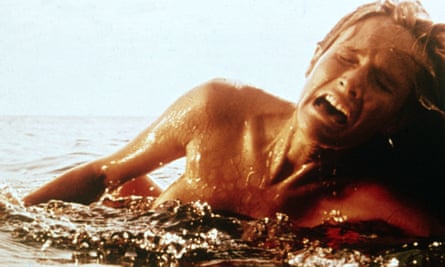
A still from the opening sequence of Steven Spielberg’s classic Jaws. Photograph: Fotos International/Getty Images
Jaws opened across North America on 464 screens amid an unprecedented publicity blitz: $2.5m was spent on promotion, a substantial chunk of which went on TV advertising, still a novelty at that time. Promotional tie-ins, including Jaws-themed ice-creams, were everywhere. I remember being on holiday in the Isle of Man long before the film’s UK opening (it didn’t arrive here until December) and buying the novel, the T-shirt and a garish Jaws pendant, all on the strength of the insane levels of news coverage that the film’s US opening provoked. “Lifeguards were falling asleep at their stations,” remembered the film’s other producer, Richard Zanuck, “because nobody was going in the water; they were on the beach reading their book”. In the first 38 days of its release, Jaws sold 25m tickets; its rentals in 1975 were a record-breaking $102.5m. When adjusted for inflation, the film’s total worldwide box office is now estimated at close to $2bn.
Such staggering success proved game-changing, establishing the financial merit of the “front-loading” strategy, which used saturation marketing to turn a movie into an event. According to Carl Gottlieb, who shares Jaws’s screenwriting credit with Peter Benchley: “That notion of selling a picture as an event, as a phenomenon, as a destination, was born with that release.”
Today, received wisdom has it that Jaws essentially redefined the economic models of Hollywood. This change led to some staggering box-office bonanzas, but it has come at a price. “My husband keeps citing this as the movie that changed the way movies are made,” says Jaws actress (and wife of former Universal boss Sid Sheinberg) Lorraine Gary (Ellen Brody) in the 1997 BBC documentary In the Teeth of Jaws. “It got us to where we are today, which is, if it’s not a hundred-million-dollar movie, it doesn’t get the kind of support it needs from the studio. It was a good thing at the time [but] it’s an awful legacy to now have everyone used to an enormous hit-you-over-the-head television campaign which costs so much money.”
Whether or not Jaws really did change the film industry for ever is one of the subjects to be debated at the
Jaws 40th Anniversary Symposium at De Montfort University, Leicester, later in June. Here, prominent academics Peter Krämer and Sheldon Hall will go head to head on the still-heated question of whether Jaws was indeed the “first blockbuster” (Hall thinks not), while others debate subjects as esoteric as “masculinity and crisis in Jaws”, “Jaws and eco-feminism” and (most tantalisingly) “Jaws: the case of the archetypal American villain as queer dissident attacking the heteronormative”.
Conference convener Ian Hunter says that the purpose of the event is to investigate the movie’s progress from popcorn hit to cinema classic. “The thing about Jaws is that it’s open to so many interpretations,” says Hunter. “It can be about Watergate, or the bomb, or masculinity, or whatever. Some critics have claimed that it marks the point that Hollywood became more interested in archetypes than characters, but it was also the birth of a new kind of family film. I remember seeing it in Plymouth on Boxing Day 1975 and thinking that this was really a film for us, for the generation of The Towering Inferno and Earthquake, offering the kind of thrills that had previously been the domain of X-rated movies. For me, it remains one of the truly great and lasting classics of American cinema, a perfect piece of movie-making.”
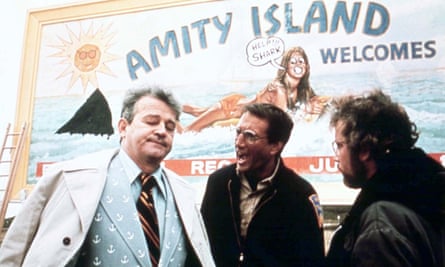
Murray Hamilton as the mayor of Amity, with Roy Scheider as police chief Brody and Richard Dreyfuss as Matt Hooper. Photograph: www.ronaldgrantarchive.com
Jaws began life as a 1974 novel by Peter Benchley about a seaside resort named Amity that is terrorised by a great white shark. Police chief Martin Brody, played by Roy Scheider in the film, orders the beaches to be closed, but the mayor and local businessmen insist they stay open – with tragic results. Eventually, Brody is forced to take to the sea with professional shark hunter Quint (Robert Shaw) and ichthyologist Matt Hooper (Richard Dreyfuss) to hunt down the shark and save the town.
Film rights were secured by Zanuck and Brown for $150,000 (plus $25,000 for a first draft of the script) before the novel had been published (the book sold 5.5m copies before the movie opened). After potential director Dick Richards reportedly blew the assignment by repeatedly referring to the shark as “a whale”, the producers turned to rising director Steven Spielberg, who had just finished work on his feature debut, The Sugarland Express, and had made waves with the TV movie Duel, which pitted an emasculated Dennis Weaver against a giant, predatory truck.
“I always thought that Jaws was kind of like an aquatic version of Duel,” Spielberg told me in 2006, when I interviewed him for a BBC Culture Show special on the eve of his 60th birthday. “It was once again about a very large predator, you know, chasing innocent people and consuming them – irrationally. It was an eating machine. At the same time, I think it was also my own fear of the water. I’ve always been afraid of the water, I was never a very good swimmer. And that probably motivated me more than anything else to want to tell that story.”
The production of Jaws proved problematic from the outset. First, there was the screenplay, which was still in flux when principal photography began in May 1974 (Richard Dreyfuss famously declared: “We started without a script, without a cast and without a shark”). Three drafts of the Jaws script were produced by Benchley before playwright Howard Sackler was brought in to do uncredited rewrites. But still things weren’t quite right and 10 days before the shoot Carl Gottlieb was enlisted to work with Spielberg on some dialogue scenes, bringing more warmth and “levity” to the often unlikable characters. Gottlieb would continue to do rewrites throughout the production, often incorporating material improvised in rehearsal by the cast, with added input from John Milius.
With a projected budget of between $3.5m and $4m, filming got under way at the Massachusetts resort of Martha’s Vineyard. Several residents were cast in minor roles, but a few feathers were ruffled by the prospect of a Hollywood production rolling into town. “Martha’s Vineyard is a very upmarket place,” says Nick Jones, producer/director of In the Teeth of Jaws. “There is a somewhat snobby element of the super-rich, but the businesses rely on tourist dollars. So there was a little tension between those who wanted the film crew there and those who didn’t. For example, when the production needed to build Quint’s shack on a vacant harbour lot, they were refused planning permission even though it was only a set. Finally, they were allowed to continue on the proviso that they put everything back exactly the way it was, including the trash!”
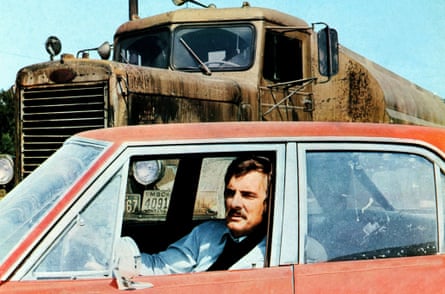
Dennis Weaver in Spielberg’s TV movie Duel, in which a monster truck plays predator. Photograph: Allstar/UNIVERSAL TV/Sportsphoto Ltd./Allstar
Nowadays, Martha’s Vineyard attracts a steady stream of tourists eager to visit the locations where Jaws was filmed. “It really is like walking around a movie set,” says Jones. “Before Jaws, there was a certain notoriety from the Ted Kennedy
Chappaquiddick scandal, but the movie really eclipsed that. When we were making the documentary, we went with Lee Fierro [the Martha’s Vineyard resident who plays Mrs Kintner in the movie] to the stretch of coast where the beach scenes for Jaws were filmed. It’s very exciting to see those vistas that have become so iconic. And we got taken out to the wreck of the Orca [Quint’s boat], which was just a shell sticking out of the edge of the water. It was bizarre; we stood in it and touched it – it was like touching a piece of the true cross.”
The Jaws shoot was originally scheduled for 55 days, but the production swiftly turned into a logistical nightmare when the mechanical shark (three full-size, pneumatically animated models were constructed) consistently failed to play ball. Nicknamed Bruce after Spielberg’s lawyer, Bruce Ramer, the shark had been built by Bob Mattey, who had created the giant squid for 20,000 Leagues Under the Sea. The models worked fine in the warehouse, but the minute they were dumped into seawater, they started to malfunction. Day after day went by without any usable footage being shot, storms and seasickness the film-makers’ only reward.
Recalling the ordeal of the shoot, Spielberg told me: “Jaws to me was a near-death experience – and a ‘career death’ experience! I went to a party on Martha’s Vineyard and a very well-known actress came over to me and said, ‘I just came back from LA and everybody says this picture is a complete stinker. It’s a total failure and nobody will ever hire you again because you’re profligate in your spending and you’re irresponsible. Everybody’s calling you irresponsible!’ I had never heard the scuttle before, I didn’t ever hear the noise that was coming from Hollywood about me. So I was halfway through shooting the picture and this person tells me that my movie’s a disaster, and I am a disaster, and it’s over. And I really believed for the second half of the film that this was the last time I was ever going to shoot a film on 35mm.”
The lengthy shoot took its toll on the cast too. In particular, tensions emerged between Dreyfuss and Shaw to match those between their respective characters, ichthyologist Matt Hooper and crusty shark-hunter Quint. Partly modelled on local character Craig Kingsbury (who has a small role in the movie as the ill-fated Ben Gardner), Quint is a hard-drinking troublemaker who takes pleasure in taunting his city boy colleagues. It was a role into which Shaw threw himself with scene-stealing gusto, to the alarm of Dreyfuss. “There was a kind of sparring that went on between us,” Dreyfuss told the BBC in 1997. “It was both playful and – on my part – desperate. [Shaw] knew how to dish it out so you had to learn how to dish it back. He could be very vicious and his humour could be very cutting.” And, like his character, Shaw enjoyed a drink.

The filming of the famous dolly zoom shot (pioneered in Hitchcock’s Vertigo) on the beach. Photograph: MPTVA/HA/LFI
But while Shaw proved a somewhat volatile presence, his work on screen was note-perfect, which was more than could be said for the shark. By the time the film-makers had enough usable footage in the can, the production was more than 100 days over schedule, with the budget spiralling toward the $9m mark, $3m of which had been blown on what Spielberg derisively called “the special defects department”. Yet Bruce’s failure to function proved the making of the film. Unable to get the shark action shots he wanted, Spielberg was forced to take a more Hitchcockian approach, working with editor Verna Fields to conjure tense sequences in which what we don’t see is more important that what we do. Meanwhile, composer John Williams filled in the gaps where the shark should be with an ominous score that has become as synonymous with screen terror as Bernard Herrmann’s themes from Psycho. The result was pure magic, causing Spielberg to concede that “had the shark been working, perhaps the film would have made half the money and been half as scary”.
It wasn’t until Jaws was test-screened at the Medallion theatre, Dallas, in March 1975 that the film-makers got the sense that they were on to a hit. “That was the first time I realised that the shark worked, the movie worked, everything about it worked,” Spielberg told me. “The audience came out of their seats. Popcorn was flying in front of the screen twice during the movie. And then I got greedy and thought, gee, could I make the popcorn fly out of their boxes three times? And that’s when I shot that scene in my editor Verna’s pool. I had this idea that maybe when Richard [Dreyfuss] goes underwater to dig the tooth out [of the sunken boat], what if Ben Gardner’s entire head comes out of the hole? And so I shot it in her pool with a prosthetic head and a plywood boat.”
The scene of Ben Gardner’s mutilated head floating into view did indeed prove a showstopper. It was just one of a number of intense, gory sequences that earned Jaws the reputation of being the most shocking movie ever to be awarded a family-friendly PG rating in the US. Writing in the Los Angeles Times, critic Charles Champlin complained that “the PG rating is grievously wrong and misleading… Jaws is too gruesome for children and likely to turn the stomach of the impressionable at any age.” (The Motion Picture Association of America defended its lenient rating by pointing out that “nobody ever got mugged by a shark”.)
All of which brings us back to the thorny question of what Jaws is really about. For years, I have insisted that Jaws is a classic monster movie “morality tale” in which the watery fate of potential victims is sealed by their on-land behaviour. Stephen King memorably wrote: “Within the frame of most horror tales we find a moral code so strong it would make a Puritan smile”, and that certainly seems to apply to Jaws. Key to this reading is the character of Hooper, who [plot spoilers ahead!] dies in the novel after having a sordid fling with Brody’s wife, Ellen, but miraculously survives on screen, largely because the affair doesn’t happen in the film. Benchley, who makes a cameo appearance in the movie as a news reporter, remembers that the very first thing Zanuck told him when writing the script was to lose “that love story, the whole sex nonsense”. Spielberg agreed, confirming to me that “my first impulse was to get rid of the melodrama and the soap opera aspects of the novel, the whole love affair with the ichthyologist and the police chief’s wife”. Instead, he wanted to “go right for that third act”, cutting to the chase with dramatic results. But once the affair had been removed, so too was the subtextual justification for Hooper’s violent death.
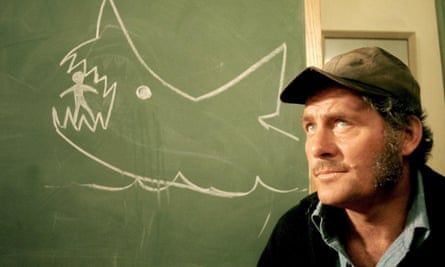
Robert Shaw as Quint, the fisherman who agrees to hunt down the shark, in Jaws. Photograph: Everett/REX_Shutterstock
Although the official explanation for Hooper surviving the shark-cage attack was the unplanned wrecking of the empty cage by a real-life predator (and stuntman Carl Rizzo’s understandable reluctance to get back in the water), it seemed clear to me that without the infidelity subplot Hooper became a heroic character who had to live. When I interviewed Spielberg in 2006, he reluctantly conceded that there was some logic in this. But by the time I spoke to him again in 2012, for BBC Radio 5 Live, he wasn’t buying it.
“The shark doesn’t care whether you’re married or single,” he laughed. “It just wants to eat ya!” But what about Hooper’s survival? I insisted. Surely that only makes sense because you cut out the affair? “Well, I cut the soap opera because I wanted to go out and do a sea-hunt movie,” Spielberg demurred. “I wasn’t interested in doing Peyton Place.”
So, Jaws isn’t a film about infidelity? (Or masculinity? Or Watergate? Or whatever?)
“No,” replied Spielberg definitively. “It’s a film about a shark.”