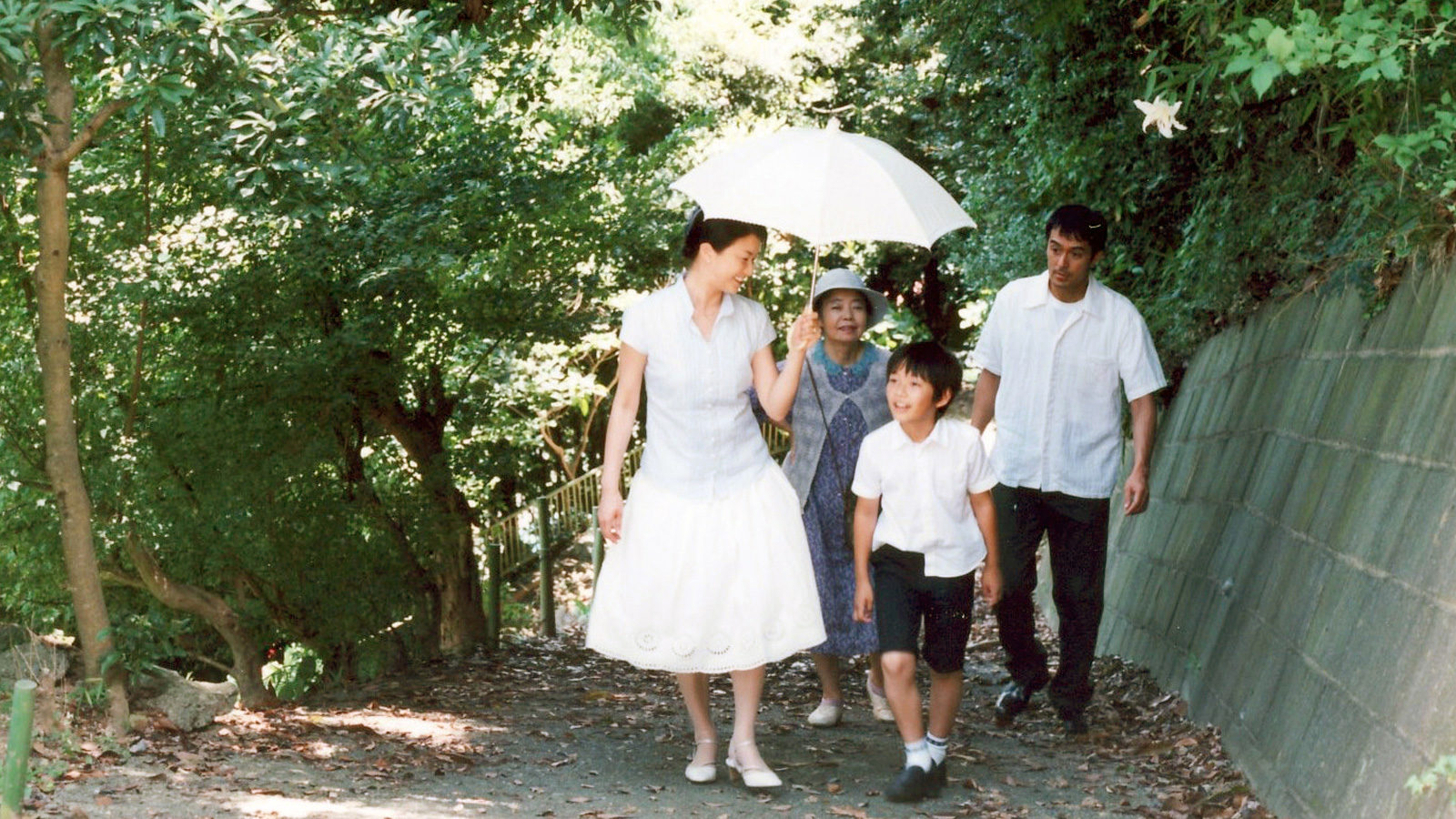
“Without mercy, man is like a beast. Even if you are hard on yourself, be merciful to others. Men are created equal. Everyone is entitled to their happiness. “
Steve Vineberg, Critic at Large
“A slave becoming a governor, that’s a true fairy tale!” – Sansho to Zushio in Sansho the Bailiff
Of the three filmmakers I think of as the supreme masters of Japanese cinema – Kenji Mizoguchi, Akira Kurosawa and Kon Ichikawa – Mizoguchi arrived and departed earliest. But even though he died of leukemia in 1956, at the age of 58, he had an amazing career that began in the silent era and produced 86 movies. (Nearly two-thirds of them have been lost.) Among his late pictures are several that may have been Japan’s first feminist movies: The Life of O-haru, Street of Shame and A Geisha, which deal candidly with traditional options for women at different points in Japanese society. But his signal qualities are his painterly style – no Japanese director has approached more closely, or more poignantly, the enchanted delicacy of Japanese prints – and his narrative sweep. The Mizoguchi movies I love best are like tales from The Arabian Nights: the erotic ghost story Ugetsu (1953), the dark Cinderella story The Princess Yang Kwei Fei (1955) and especially Sansho the Bailiff (1954), which is his masterpiece.

The themes of Sansho (which is available in a beautiful print on Criterion Channel and on Blu-Ray and DVD) are empathy and – three that are hooped together – legacy, identity and memory. The screenplay by Fuji Yahiro and Yoshikata Yoda, adapted from a short story by Ogai Mori, has the rhymed elegance of a classic fable. During Medieval times, Masauji Taira (Masao Shimizu), the governor of Tango, is relieved of his post because his kindness to the peasants under his care opposes the self-serving dicta of the feudal regime (he protests against conscription and increased taxes, both of which feed the current wars). Before he takes leave of his family, who are being sent to live with his brother-in-law, he gives his son Zushio an amulet, an icon of the goddess of mercy, instructs him that all men are created equal, and has him repeat these words: “A man is not a human being without mercy. Even if you are hard on yourself, be merciful to others.” After six years Zushio and his sister Anju and their mother, Tamaki (the exquisite Kinuyo Tanaka, who also appears in both The Life of O-haru and Ugetsu) leave her brother’s home, following Taira’s path, but they never reach him. On the way a priestess who feeds them and puts them up for the night betrays them to local bandits: they pull the children away from their desperate mother and toss her faithful servant (Chieko Naniwa) into the sea. (It’s unlikely that anyone who sees the movie can ever forget this scene.) They sell Tamaki to a brothel on the island of Sado while the children remain on the mainland, enslaved to Sansho the bailiff (Eitarô Shindô), who collects taxes for the Minister of the Right. Technically the slaves belong to the minister, but it’s Sansho who works them to the bone. With a thin fringe of hair at the bottom of his bald skull and a beard that looks like pieces of straw glued randomly to his chin, Sansho suggests a Japanese folk-fable version of a Dickens figure, and this section, the longest in the movie, where we witness the cruelties he inflicts on his slaves, is distinctly Dickensian.
Sansho’s words are in direct opposition to Taira’s: “Give them no sympathy.” Mizoguchi pits nobility against baseness, cruelty against humanism. We’re alerted to the distinction between those who behave with kindness and those who, like Sansho and the priestess, behave monstrously. When the children first arrive, another slave, Namiji (Kimiko Tachibana), is instinctively generous with Anju; she’s moved to think of her own absent children, and she tries to escape to get to them. But she doesn’t get far, and Sansho sentences her to the usual punishment for runaways, branding. He orders his son Taro (Akitake Kôno) to execute it, but Taro, who is repelled, refuses, to his father’s disgust. The young man is drawn to the children. When they refuse to give their names he assumes that they are nobly born (and probably fear being held for ransom) and offers them new ones – Mutsu for Zushio, Shinobu for Anju. (Lost identity is, of course, a convention of fairy tales.) In response to his solicitousness, Mutsu teaches Taro his father’s principle, and though Taro doesn’t have the means to help them get back to their parents, he’s inspired by Taira’s teachings to run away from his monstrous father.

Mutsu/Zushio and Taro are foils in this movie – both the sons of powerful men, one noble and one cruel, who exert a strong influence, positive or negative, on their visions of the world. And both turn against the teachings of their respective fathers. Ten years pass and Mutsu (Yoshiaki Haniyagi), now 23, has forgotten his, though Shinobu (Kyôko Kagawa), sweet and gentle-hearted at 18, keeps trying to remind him.
He has learned to curry favor with Sansho by discharging his most despicable orders, like branding a seventy-year-old slave (Ichirô Sugai) when he tries to run away so that, after half a century in captivity, he can die a free man. Obviously the two punishment scenes are juxtaposed in Mizoguchi’s thematic structure – and eventually Taro and Mutsu’s fates cross again, and in a way that again includes Namaji. Sansho determines that she’s now too old and sickly to work, so he commands Mutsu to dump her in the forest to die. Shinobu asks to accompany them so she can try to alleviate the end of Namaji’s life in a few small ways – placing a stick in her hand that’s tied to a small statue of Buddha, gathering straw and grass to ward off the frost. Instinctively Mutsu helps her and she recalls – as we do – the last time they did this, as children, making camp for their mother on their travels the night before they were kidnapped. We remember the plaintive quaver in Tamaki’s voice when she called them to gather around the fire for dinner – and we hear it again when her ballad for her lost children wafts across the water. Shinobu has heard it before, very recently, when a newcomer to the manor from Sado sang it; the young woman didn’t know Tamaki’s name but the lyrics of the song have both Zushio and Anju’s names embedded in it. And we know what they don’t, because Mizoguchi has followed the introduction of the ballad with a cut to Tamaki’s life as a courtesan named Nakagimi. She has tried to run away to find her children so often that finally the brothel keeper has her tendon cut – and her fellow courtesans have to carry her to the beach so that she can at least see the mainland. Now her children hear her voice on the wind, and Mutsu, returned to himself at last, begins to sob.

It’s his idea for them to escape, but Shinobu persuades him to go without her and to take Namaji with him. His act of kindness – ferrying her on his back and depositing her at a local monastery where Taro is now a priest – counters his act of cruelty to the old man. Taro’s medicine saves Namaji’s life, and though his own efforts to bring down his father by appealing to the Chief Advisor (Prime Minister) failed, he hopes that Mutsu, bearing a letter from the monastery, will have more success. Taro’s inability to influence the government against his father’s injustices has made him cynical, but Mutsu’s newly reborn optimism and righteousness – the re-emergence of his father’s spirit within him – reactivates his own. Mutsu doesn’t know that Shinobu has sacrificed herself for him, drowning herself so that Sansho’s torturers can’t get her to reveal where her brother has gone. Walking toward her mother’s voice on the wind, she disappears into the misted sea like a water sprite, becoming a ring of ripples on the surface of the water. This must be one of the most beautiful images in world cinema. It’s like a transformation in a myth, where a character dies tragically but the gods, in compensation, turn her into a tree or some other element of nature.
 |
Kyôko Kagawa in Sansho the Bailiff (1954).
|
After a struggle – one of those moments in a fairy tale when the hero reaches the depths of despair before resurfacing in hope – Mutsu gets the ear of the Chief Advisor, who recognizes the amulet and gives the young man his father’s old job, the governorship of Tango. Zushio/Mutsu gets another name change – he becomes Masamichi Taira. And he really does seem to be Taira resurrected. Risking exile like his father, he invades Sansho’s manor and liberates the slaves, even though they are the property of the Minister of the Right and the governor has no jurisdiction over a private residence. Of course, he believes that he has come back to rescue his sister, but, having learned from the Chief Advisor that his father died just the year before, he now learns that he has lost Anju as well.
There’s a stunning moment when Zushio, returning to Sansho’s manor as Governor Masamichi, kneels to beg forgiveness of the old man he branded. But the final scene, where he’s reunited with the only other surviving member of his family, his mother, on the beach at Sado, is simply one of the greatest sequences ever put on film. At first he’s told that she was a casualty of a tsunami, so he expects that, as with Anju, he’s going to visit her watery tomb. But as he approaches the water’s edge he hears Tamaki’s ballad, with its refrain, “Isn’t life a torture?,” and he finds her, a wreck of a woman, now blind, pounding the shore with a stick and repeating her song in a gravelly remnant of her old voice. Mizoguchi’s model here must have been the reunion scene from King Lear. At first, like Lear, Tamaki doesn’t believe this can possibly be her son – not because (like Lear) she fears her wits are failing but because she thinks someone is playing a trick on her. But Zushio places the amulet in her hands, and she feels his beloved face. After telling her that his father and sister are both dead, weeping, he begs her forgiveness for not coming sooner. In Lear the broken old man tells his daughter Cordelia meekly that he knows she has cause to hate him and the only words she can get out are “No cause, no cause.” Four words – and it is, for me, the most profoundly moving line in the history of theatre. I hear it in my head every time I watch the final scene of Sansho the Bailiff when Tamaki assures her son that he has nothing to be forgiven for. This time around I said it out loud, through my own tears.

-----------------------
The Seventh Art, Srikanth Srinivasan
As clarified in the opening quote (“This tale is set during the late Heian period an era when mankind had not yet awakened as human beings. It has been retold by the people for centuries and it is treasured today as one of the world’s great folk tales, full of grief.”), Mizoguchi, too, proclaims that the story is of the past – over and done with, its outcome fixed. Again, within the film he furnishes detail using direct flashbacks or visual fragments from the past.

-----
For the most part, Sansho is a cruel film. The very title of the film is based on the name of the villain and not Zushio. It presents hope neither for its characters nor its audience. In the poignant final scene, as mother and son reunite, Mizoguchi’s camera pulls away dwarfing them in comparison to the landscape that is as serene and pacific as it was during the beginning of the entire ordeal. It is as if this majestic nature is completely indifferent to the ephemeral travails and triumphs of human beings. What takes a lifetime for the ant-like characters is nothing more than a fleeting instant for nature, which continues to concoct its own tragedies. Often, we see barren and crooked trees taking over the characters in the frame almost in an expressionistic manner. True that nature regularly comments upon their situation but it never does anything to alter it (“Even children as young as you are sold and bought, treated like animals and nobody questions it”, says a character).
The only hope that Mizoguchi presents in the film is by situating the tale in the past – by providing an apparent relief that all the pain and suffering is over and humanity has been discovered (“…an era when mankind had not yet awakened as human beings.”). But reading the opening quote once more, one can feel a strong vein of sarcasm running through. Is Mizoguchi decidedly making it a period drama? Or is there something more “present” to the tale? The situation in post-war Japan, contained, not very surprisingly, atrocities committed by the occupying forces in the country during the post-war period and also a foundation known as Recreation and Amusement Association that has similarities to the Geisha-slave system that Sansho talks about.
----------
Sansho the Bailiff Blu-ray Review
Heartbreaking performances abound in the film, especially among the three principals. Yosiaki Hanayagi as the shamed son who rises to great power only to risk it all for his sense of what’s right and honorable has the deepest emotional journey of the leads, and his performance is superb. As his gentle sister who’s far stronger than anyone suspects, Kyoko Kagawa is magisterial. With less screen time, actress Kinuyo Tanaka still makes a lasting impression early in the film and then in the film’s final few moments as the children’s desperate mother. As the title character, Eitaro Shindo is properly blustery and appalling.

...one of the great emotional and philosophical journeys ever made for the cinema. Possibly the high point of an unbroken string of masterpieces made by Kenji Mizoguchi shortly before his death, Sansho the Bailiff features the perfection of a signature visual style, made up predominately by long, complexly staged shots paced by gliding camera movements, that Mizoguchi had already begun to develop in the 1930's.....Mizoguchi's wordview is pitch black: violence, betrayal and wanton cruelty are simply the order of the day. Yet although one can't change this, one can protest by simply staying true to an ideal.The battle between good and evil is finally a battle within oneself, and in the film's magnificent final sequence, as mother and son huddle together sobbing, one feels that the love between them is the most powerful force in the universe; even if that love can't conquer the world, it can transcend it. Richard Pena


 The father is a retired physician, slowed with age, still marching joylessly on his daily walk. He stays mostly closed off in his office and greets his son brusquely. The mother has her doubts about this marriage; it is better to marry a divorced woman than a widow, because at least the divorce chose to leave her husband.
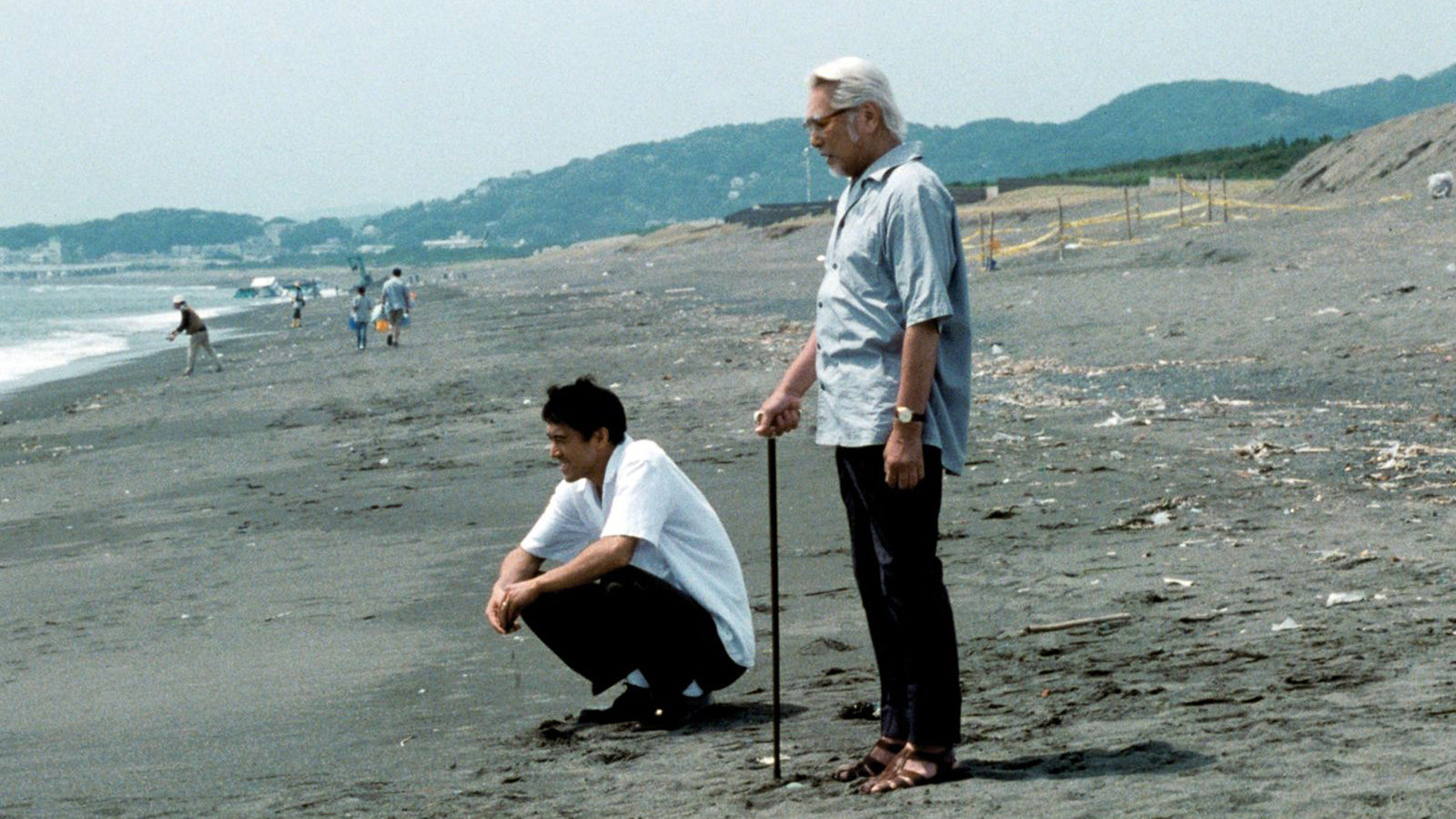 The day arrived at some sort of centerpiece when they welcome a luncheon guest, who is never named. This is the man Junpei died while saving. He is homely, fat, ill at ease, squirmy, apologetic, bursting from his white dress shirt. The doctor clearly doesn't regard him as having been worth saving. Ryota has spent a lifetime feeling shunned by his father and considered inferior to his brother. He has been wounded time and again, and so he is alert to the discomfort of the saved man. Why do they even invite him? He's obviously suffering during these annual visits. They invite him, he learns offhandedly, because he suffers.
 He feels a strong connection with spouses separated by death or circumstances, and the children who are involved. "Maborosi" involves a widow with a young son, who goes to a new seaside town to marry a virtual stranger. "After Life," a serious fantasy, is about newly dead people who spend a week in a heavenly waiting room to prepare a film of the one memory they want to carry through eternity. "Nobody Knows" is about the children of a quasi-prostitute who leaves them to fend for themselves in a city apartment.