Die Hard
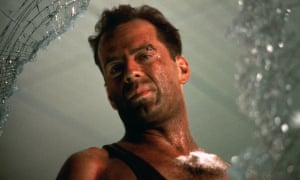 |

The first shot of John McClane in Die Hard is his left hand digging into the armrest as his plane lands at LAX. We can see he’s wearing a wedding band on his ring finger. His seatmate then gives him an unusual piece of advice about surviving air travel: once he settles in, he should take off his socks and shoes and make fists with his toes on the rug. Then he reaches up to the overhead bin, revealing a holstered gun dangling from his midsection.
All of this is mundane stuff. It’s also a prime example of why Die Hard remains the greatest American action movie since it was released 30 years ago this week.
Consider everything that the director, John McTiernan, and his screenwriters, Jeb Stuart and Steven E de Souza, set up in this brief little scene. Though Bruce Willis plays McClane as the modern American cowboy, Roy Rogers with an attitude, the film-makers choose to emphasize his vulnerability first. His fear of flying gets us primed for the bumps and bruises he will sustain all night long, when a phalanx of terrorists take over a Christmas party at Nakatomi Plaza. McClane’s most important quality isn’t his toughness, but his flesh-and-blood humanity, which is what most of the film’s sequels get wrong. The advice he gets from his seatmate gives him a reason to be barefoot during the entire ordeal, including a sequence where henchmen deliberately shoot out the glass to shred his flat soles. The gun establishes him as one of New York’s finest, and the ring suggests a commitment to his marriage that his wife Holly (Bonnie Bedelia), we soon learn, doesn’t share.
There are dozens of other examples of small, deftly planted details that will pay off later on. The first terrorist McClane kills has feet “smaller than [his] sister’s”, so he can’t take his shoes; he also happens to be the brother of Karl (Alexander Godunov), the vicious right-hand to the mastermind, Hans Gruber (Alan Rickman), which raises the stakes for their inevitable mano a mano.
There’s not a wasted moment in Die Hard, not a moment when the audience feels confused about who’s who or what’s going on or where the characters are in relation to each other. It seems like simplest, most banal part of a making a movie, but it must be the hardest, because the vast majority of actioners, even good ones, don’t succeed in doing it. Stuart and De Souza’s script is a perfectly worked-out puzzle of a thousand tiny pieces: Die Hard has at least five major villains, unfolds over multiple planes of action, and fully works out Gruber’s elaborate scheme to steal $640m in negotiable bearer bonds (he’s no mere common thief, he’s an exceptional thief) and McClane’s improvised efforts to stop it.

All the canonical moments and lines still play: McClane crawling through the air duct or leaping off the exploding roof with the firehose wrapped around his waist, any of Alan Rickman’s archly enunciated monologues: “We’re gonna need some more FBI guys, I guess”, “Yippie ki-yay, motherfucker”. The lesson of Die Hard, however, is that the small, incidental details are just as consequential – and often exactly what’s missing from the films that tried to emulate it.
:max_bytes(150000):strip_icc():focal(999x0:1001x2):format(webp)/bonnie-bedelia-bruce-willis-1-2000-3aea5c4b96004ca1b83959df86b67067.jpg)
Eric Lichtenfeld, Nat'l Film Registry
By July 1988, when “Die Hard” was released, the American action film had become its own distinct form. With “Dirty Harry” (1971), elements of the Western, film noir, the police procedural, and the horror movie began colliding to create this emerging genre, but it took the eighties for the formula to cohere.
During that decade, the Hollywood action movie also organized itself around a particular facet of the political and cultural zeitgeist: a sense of renewed American might and moral clarity that was embodied in everything from Ronald Reagan’s “Evil Empire” and “Morning in America” narratives to the public’s embrace of military camouflage as a fashion trend. Still, while the genre drew from these deep pools of film history and cultural wish fulfillment, the movies themselves were often simplistic, even brutish. It was against this backdrop that “Die Hard” cut its unlikely silhouette.
In addition to earning four Academy Award nominations and launching one of Fox’s cornerstone properties, the picture inspired so many imitators that its format became the most recognizable trend in action filmmaking for almost a decade. It may also be the bloodiest movie ever to enter the pantheon of Christmas classics.
Perhaps the aspect of the film most widely remarked upon is the everyman quality of Willis’s John McClane. And for good reason. Willis’s vulnerability and more average physique instantly made him a counterpoint to the chiseled automatons played by Arnold Schwarzenegger and Sylvester Stallone, action heroes more typical of the era. Willis and the filmmakers made McClane even more relatable to audiences by imbuing the character with a strong working-class persona. This emerges in stark relief next to the high culture embodied by Hans and the corporate culture embodied by the Nakatomi executives and the building itself. “Die Hard” also makes McClane a relatable and—even more—distinctly American hero by how it invokes popular culture. “But who are you?” Hans asks, “Just another American who saw too many movies as a child? Another orphan of a bankrupt culture who thinks he’s John Wayne? Rambo? Marshal Dillon?” McClane answers with a glib reference to Roy Rogers, and finally, with the phrase that would become one of the most iconic one-liners in a genre known for one-liners: “Yippee-kai-yay, motherfucker,” a meeting of old-time Western cheer and raised-middle-finger defiance.

Jan De Bont’s cinematography lends “Die Hard” a more sophisticated style than is commonly seen in action movies of the time. This style was informed by film noir and energized by a fluidly moving camera and an embrace of lens flares that broke with what was then accepted practice for cinematography. McTiernan also challenged aesthetic norms by enlisting editors Frank Urioste and John F. Link to edit together shots mid-motion, a stylistic choice reflecting how McTiernan was influenced by the French New Wave. Urioste and Link would be rewarded for their efforts with a shared Academy Award nomination


