DISCLAIMER

I claim no ownership of any images or writings posted here unless otherwise stated. i.e. [placed in brackets] All images and writings are owned/copyrighted by others. I make no income from their use and I am sharing them for the newsworthiness and/or cultural value they represent as well as for educational purposes. No infringement is intended and any media used is not for commercial purposes. If you are the person responsible for an image or writing that I have posted, please contact me in "comments," showing proper documentation and I will remove it immediately.

Search This Blog

Tuesday, July 1, 2025

THE SORROW AND THE PITY

Rent it on Amazon, Apple TV, Fandango at Home, Milestone and Google Play.

“The Sorrow and the Pity” is by far the most famous documentary by Marcel Ophuls. If all you know of the film is its use as a running joke in “Annie Hall,” then it is beyond time to take a look at Ophuls’s exhaustive, densely structured reconstruction of life in Clermont-Ferrand, France, during the Nazi occupation. The film has been credited with puncturing the postwar myth that France resisted German rule en masse.

Ophuls talks to resistors and admitted collaborators alike, from people who would have us believe they saw little or nothing to people who saw everything. Running nearly four and a half hours, the film is divided into two parts — “The Collapse” and “The Choice” — as it moves through how France laid down its arms against the Nazi invasion and then normalized the German presence. Witnesses discuss the attraction of fascism, loyalty to the Vichy puppet government, how movie screens remained illuminated (albeit with Nazi censorship) and how Paris, after the initial shock of capitulation, returned to a simulacrum of its vivacious self. One interviewee says that the Gestapo could not have been as destructive as it was without the help of the French police.

Part of Ophuls’s diagnosis is social. Pierre Mendès-France, a Jewish lieutenant with the French Air Force who escaped to Britain (and later, in the 1950s, served as the prime minister of France), says that it was easy for the Nazis to draw on latent antisemitism and anti-British sentiment in the country. Denis Rake, a Briton who worked in France as a secret agent during Vichy rule, points to class differences: He got the most help, he says, from railway workers. The bourgeoisie, by contrast, had more to lose.

We hear of divisions within the resistance itself — notably communist versus non-communist — and of the debates its members had about what actions to take. Ophuls shows how sentiment changed quickly after the liberation. And Emile Coulaudon, a resistance fighter who had the nom de guerre Colonel Gaspar, delivers a sobering assessment from the standpoint of more than 50 years ago: He warns of the “risk in the world of the reappearance of Nazism, or whatever goes by another name but is still Nazism.”

Monday, June 30, 2025

"GOODFELLAS": SCORSESE'S VISCERAL SYMPHONY OF AMERICAN CRIME

In the pantheon of American cinema, few works blaze with such ferocious authenticity and stylistic audacity as Martin Scorsese's "Goodfellas" (1990). This electrifying chronicle of mob life doesn't merely depict organized crime—it immerses us in its intoxicating rhythms, seductive pleasures, and inevitable moral collapse with such virtuosic filmmaking that we become complicit witnesses to its brutal beauty.

Scorsese, born to working-class Italian-American parents in Queens, brings an insider's intimate understanding to this adaptation of Nicholas Pileggi's "Wiseguy." The film embodies his career-long fascination with power, masculinity, Catholic guilt, and the dark underbelly of the American Dream. "Goodfellas" represents Scorsese at the absolute zenith of his powers, wielding every cinematic tool with breathtaking confidence to create a descent into the mafia underworld that feels simultaneously mythic and devastatingly real.

The film's propulsive energy stems from its revolutionary approach to narrative structure and visual language. Scorsese's camera never rests—it glides, swoops, and prowls through the criminal ecosystem with hypnotic fluidity. The legendary Copacabana tracking shot alone stands as a masterclass in technical bravura serving thematic purpose, as Henry Hill's seductive entry into the privileged realm of mobsters unfolds in one unbroken movement that pulls us into his intoxicating new reality.

Ray Liotta delivers a career-defining performance as Hill, capturing the character's evolution from wide-eyed aspirant to paranoid cocaine addict with remarkable precision. His voiceover narration—intimate, conspiratorial, and increasingly frantic—creates an unsettling complicity between protagonist and audience. Robert De Niro brings frightening stillness to the role of Jimmy Conway, his understated menace a perfect counterpoint to Joe Pesci's explosive Tommy DeVito—a performance of such volatile unpredictability that scenes vibrate with the possibility of imminent violence. Who can forget the‘How the fuck am I funny?’ routine.

The film's brilliant use of music deserves particular note. Rather than commissioning a traditional score, Scorsese weaves a tapestry of period-specific pop songs that function as emotional timestamps, charting the narrative's progression from the romantic doo-wop of the 1950s to the paranoid chaos of the 1980s.

"Goodfellas" transforms the gangster film from romanticized mythology into visceral anthropology. It depicts the mafia not as a shadowy organization of masterminds but as a dysfunctional workplace populated by volatile personalities governed by Byzantine codes of conduct. The film's genius lies in how it seduces us with the glamour and camaraderie of mob life before methodically stripping away the façade to reveal its hollow core.

Thelma Schoonmaker's revolutionary editing creates a rhythm that mirrors Henry's psychological state—elegant and measured in the glory years, increasingly fragmented and chaotic as his world disintegrates. The cocaine-fueled final day sequence remains an unparalleled depiction of paranoia, with its frenetic cutting and disorienting perspective shifts.

Three decades after its release, "Goodfellas" continues to reverberate through contemporary cinema and television, its DNA evident in works from "The Sopranos" to "Breaking Bad." Scorsese's masterpiece stands as both definitive gangster film and searing deconstruction of the genre.

As far back as I can remember, I always wanted to be a gangster.’ Ray Liotta’s opening line is the crime movie equivalent of ‘Once upon a time…’, and what follows is Martin Scorsese’s version of a fairy tale – the story of a starry-eyed Brooklyn kid who realises his boyhood dream and still comes out a schnook in the end. Based on the true life of mobster Henry Hill, Goodfellas was born in the shadow of The Godfather, but as the years go on, the question of which is more influential becomes mostly a matter of generation. Certainly, the former is more easily rewatchable, owing to its breakneck pacing – its two and a half hours (and three decades) just whiz by. And for a movie about violent career criminals, it’s also strangely relatable. Where Coppola went inside the walls of organised crime’s one percent, Scorsese’s gangsters are more blue collar. And as it turns out, working for the mafia isn’t much different than any other job - you spend 30 years busting your hump to climb the ladder, only to end up face down on a bloody carpet in some tacky house in the burbs. — Matthew Singer


Sure, it’s a rush – but is that enough? ‘Goodfellas’ is often heralded as Martin Scorsese’s masterpiece, and there’s no ignoring the full-throttle intensity and bravura visual style that underpin the real-life tale of small-time gangster Henry Hill (Ray Liotta) as he rises and falls through the ranks of the New York mob. It’s a film of perfect moments: Henry’s ‘As long as I can remember’ voiceover at the start; a breathtaking tracking shot through the back rooms of a nightclub; Joe Pesci’s unforgettable ‘How the fuck am I funny?’ routine.

But it’s hard to shake the feeling that, rather like its characters, ‘Goodfellas’ lacks heart. This is a story of awful creeps and the women who love them, so it was never going to be a festival of feelgood. But the sinuous coldness of the camerawork, the viciousness of the violence and the depth of the degradation all make it easy to admire, but hard to really love. In ‘Mean Streets’ and even ‘Taxi Driver’, Scorsese made his loser heroes relatable. In ‘Goodfellas’, they’re just a bunch of well-dressed dirty rats.
Written byTom HuddlestonMonday 16 January 2017

SCATTERED CLOUDS


Scattered Clouds
June 29th 2025

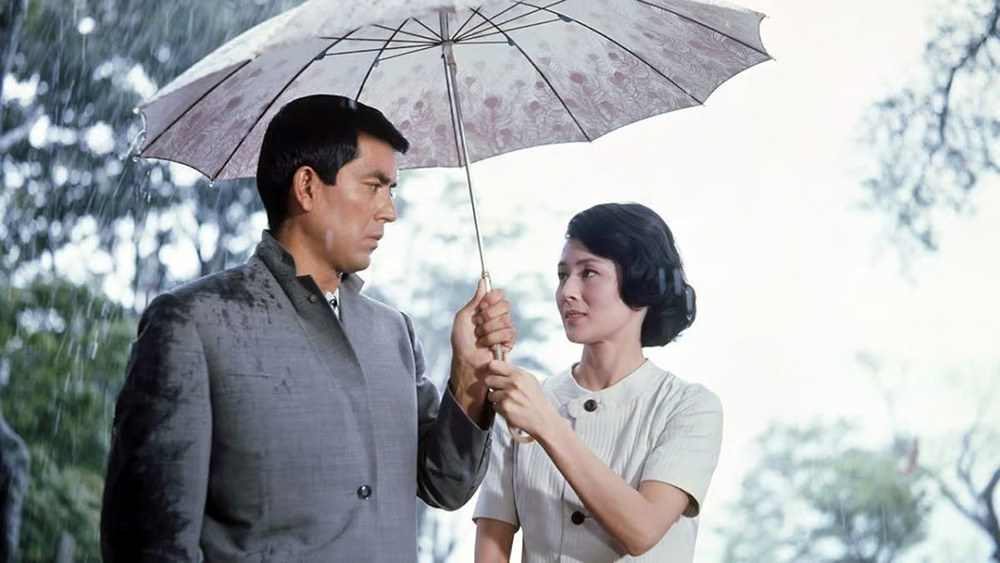
Mikio Naruse’s final film, Scattered Clouds (1967), follows Yumiko (Yoko Tsukasa), a woman whose life is upended when her husband dies in a sudden car accident caused by Shiro (Yuzo Kayama), a driver for hire. Despite being found not guilty in court, Shiro is consumed by guilt and offers his financial penance to Yumiko. She initially refuses. Legally disowned by her husband’s family and consequently stripped of his meager pension, she reluctantly returns to her rural hometown by Lake Towada, where her sister, also a widow, runs a hotel. Through sheer coincidence, Shiro’s work transfers him to the same area. Their paths cross once again, and a tense connection fraught with grief and unspoken attraction begins to blossom. Shiro and Yumiko’s fates are intertwined, yet reconciliation is impossible.

There is an abiding tension between personal grief and external expectations throughout Naruse’s oeuvre. Yumiko longs to mourn her husband in solitude, but her in-laws, sister, and even Shiro impose their own demands upon her: pushing her toward a second marriage, relocation, and financial pragmatism. Her desires clash with the demands of those around her to just move on from her husband’s sudden death. Despite Yumiko’s best efforts, her lack of agency and financial independence forces her to accept money she doesn’t want and leave Tokyo for the countryside. While starkly exposing the financial fragility of widowed women in 1960s Japan, Naruse captures the agony of being surrounded yet profoundly alone, where every well-meaning intervention only deepens an individual’s estrangement from their own feelings.

Naruse portrays the emotional and societal pressures faced by his characters with bluntness as they stubbornly move through life while privately struggling to process their tragedies. His restrained dialogue and prolonged glances convey more than words: Yumiko and Shiro’s interactions are charged with unspoken grief, shame, and longing. They both avoid facing the reality of their experiences by using alcohol, denial, and forced new beginnings to distract themselves, putting the ways people navigate the difficulties of life without truly confronting them on unfettered display. Shot on lush Tohoscope, the Lake Towada landscape contrasts with the film’s bleak themes of financial instability, widowhood, and the quiet agony of repressed emotions. Ultimately, Scattered Clouds is a poignant exploration of guilt, loss, the complexity of love, and the cruel irony of fate, underscored by Naruse’s signature restraint and empathy for the frailty inherent to the human condition.

Sunday, June 22, 2025

JAWS, 50 years on: ‘One of the truly great and lasting classics of American cinema’


MARK KERMODE, THE GUARDIAN

The true meaning of Jaws has been picked over by critics and academics ever since its release in June 1975, and even its status as the first summer blockbuster has been questioned. But isn’t it just about a killer shark?
First things first; Jaws is not about a shark. It may have a shark in it – and indeed all over the poster, the soundtrack album, the paperback jacket and so on. It may have scared a generation of cinemagoers out of the water for fear of being bitten in half by the “teeth of the sea”. But the underlying story of Jaws is more complex than the simple terror of being eaten by a very big fish. As a novel, it reads like a morality tale about the dangers of extramarital sex and the inability of a weak father to control his family and his community. As a film, it has been variously interpreted as everything from a depiction of masculinity in crisis to a post-Watergate paranoid parable about corrupt authority figures. But as a cultural phenomenon, the real story of Jaws is how a B-movie-style creature-feature became a genre-defining blockbuster that changed the face of modern cinema. In the wake of the epochal opening of Jaws 40 years ago, the film industry would find itself on the brink of a brave new world wherein saturation marketing and mall-rat teen audiences were the keys to untold riches. To this day, many consider the template of contemporary blockbuster releases to have been laid down in the summer of 1975 by a movie that redefined the parameters of a “hit” – artistically, demographically, financially.

According to David Brown, one of the film’s producers: “Almost everyone remembers when they first saw Jaws. They say, I remember the theatre I was in, I remember what I did when I went home – I wouldn’t even draw the bathwater.” I was no exception. I first saw the movie at the ABC Turnpike Lane in north London at the age of 12. It was a Sunday afternoon and I’d had to catch two separate buses to get to the cinema. I sat on the right-hand side of the packed auditorium and I remember very clearly finding the opening sequence so alarming that I wasn’t sure I’d be able to get through the rest of the film. As I told director Steven Spielberg several decades later, watching poor Susan Backlinie being dragged violently back and forth by an unseen underwater assailant, screaming blue murder, I genuinely feared that I would lose control of my bodily functions (“I like that!” laughed the director).


The lenient A certificate had meant that I’d been able to see the movie on my own, without an accompanying parent or guardian, merely the warning that “the film may be unsuitable for young children”. But the entire cinema seemed utterly traumatised by that unforgettable opening sequence, and in the wake of this ruthlessly efficient curtain-raiser (you see nothing, but fear everything), two people hurried to the exit. As they left, I remember whispering to myself in a state of sublime terror: “I am never going swimming again, I am never going swimming again…”
Jaws official trailer.

This, of course, had been the reaction of millions of cinemagoers in the US, where Jaws had become a summer movie sensation. In his influential essay, The New Hollywood, film historian Thomas Schatz notes that Jaws “recalibrated the profit potential of the Hollywood hit and redefined its status as a marketable commodity and cultural phenomenon as well”. Significantly, it achieved this success at a time when “most calculated hits were released during the Christmas holidays”. Not so Jaws, which according to David Brown was “deliberately delayed until people were in the water off the summer beach resorts”. Indeed, one of the film’s most memorable tag-lines was “See it before you go swimming!”. Yet it wasn’t just the resorts where Jaws showed its box‑office teeth.

Despite the fact that the summer months had traditionally been slow for cinemas (why go to the movies when the sun is shining?), Spielberg’s brilliantly constructed shocker struck a nerve with young audiences whose natural environment was not the beach but the shopping mall. Between 1965 and 1970, the number of malls in America had grown from 1,500 to 12,500 and Jaws rode high on the growing wave of multiplex cinemas that these urban meccas increasingly housed. Along with confirming “the viability of the summer hit, indicating an adjustment in seasonal release tactics”, Schatz also argues that Jaws struck a chord with a new generation of moviegoers who had “time and spending money and a penchant for wandering suburban shopping malls and for repeated viewings of their favourite films”. It didn’t hurt that these malls were air-conditioned, with the multiplex cinemas they increasingly housed providing a cool alternative to the sweltering summer heat.

In the wake of Jaws’s extraordinary success, film-makers and studios started to see the summer months not as dog days but as prime time, something that had previously only been true for the declining drive-in market. “The summer blockbuster was born on 20 June 1975, when Jaws opened wide,” wrote the Financial Times’s Nigel Andrews, adding: “In the years after Jaws, the entire release calendar changed.”

This change was apparently confirmed two years later by the May 1977 opening of George Lucas’s Star Wars, with its sequels The Empire Strikes Back and Return of the Jedi setting new benchmarks for seasonal franchise profitability. In the process, Steven Spielberg and George Lucas became two of the most influential people in Hollywood, the men who, according to popular folklore, had invented the “summer blockbuster”.
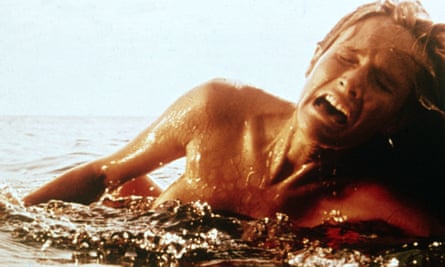
A still from the opening sequence of Steven Spielberg’s classic Jaws. Photograph: Fotos International/Getty Images

Jaws opened across North America on 464 screens amid an unprecedented publicity blitz: $2.5m was spent on promotion, a substantial chunk of which went on TV advertising, still a novelty at that time. Promotional tie-ins, including Jaws-themed ice-creams, were everywhere. I remember being on holiday in the Isle of Man long before the film’s UK opening (it didn’t arrive here until December) and buying the novel, the T-shirt and a garish Jaws pendant, all on the strength of the insane levels of news coverage that the film’s US opening provoked. “Lifeguards were falling asleep at their stations,” remembered the film’s other producer, Richard Zanuck, “because nobody was going in the water; they were on the beach reading their book”. In the first 38 days of its release, Jaws sold 25m tickets; its rentals in 1975 were a record-breaking $102.5m. When adjusted for inflation, the film’s total worldwide box office is now estimated at close to $2bn.

Such staggering success proved game-changing, establishing the financial merit of the “front-loading” strategy, which used saturation marketing to turn a movie into an event. According to Carl Gottlieb, who shares Jaws’s screenwriting credit with Peter Benchley: “That notion of selling a picture as an event, as a phenomenon, as a destination, was born with that release.”

Today, received wisdom has it that Jaws essentially redefined the economic models of Hollywood. This change led to some staggering box-office bonanzas, but it has come at a price. “My husband keeps citing this as the movie that changed the way movies are made,” says Jaws actress (and wife of former Universal boss Sid Sheinberg) Lorraine Gary (Ellen Brody) in the 1997 BBC documentary In the Teeth of Jaws. “It got us to where we are today, which is, if it’s not a hundred-million-dollar movie, it doesn’t get the kind of support it needs from the studio. It was a good thing at the time [but] it’s an awful legacy to now have everyone used to an enormous hit-you-over-the-head television campaign which costs so much money.”

Whether or not Jaws really did change the film industry for ever is one of the subjects to be debated at the Jaws 40th Anniversary Symposium at De Montfort University, Leicester, later in June. Here, prominent academics Peter Krämer and Sheldon Hall will go head to head on the still-heated question of whether Jaws was indeed the “first blockbuster” (Hall thinks not), while others debate subjects as esoteric as “masculinity and crisis in Jaws”, “Jaws and eco-feminism” and (most tantalisingly) “Jaws: the case of the archetypal American villain as queer dissident attacking the heteronormative”.

Conference convener Ian Hunter says that the purpose of the event is to investigate the movie’s progress from popcorn hit to cinema classic. “The thing about Jaws is that it’s open to so many interpretations,” says Hunter. “It can be about Watergate, or the bomb, or masculinity, or whatever. Some critics have claimed that it marks the point that Hollywood became more interested in archetypes than characters, but it was also the birth of a new kind of family film. I remember seeing it in Plymouth on Boxing Day 1975 and thinking that this was really a film for us, for the generation of The Towering Inferno and Earthquake, offering the kind of thrills that had previously been the domain of X-rated movies. For me, it remains one of the truly great and lasting classics of American cinema, a perfect piece of movie-making.”
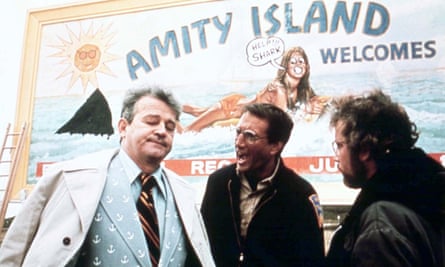
Murray Hamilton as the mayor of Amity, with Roy Scheider as police chief Brody and Richard Dreyfuss as Matt Hooper. Photograph: www.ronaldgrantarchive.com

Jaws began life as a 1974 novel by Peter Benchley about a seaside resort named Amity that is terrorised by a great white shark. Police chief Martin Brody, played by Roy Scheider in the film, orders the beaches to be closed, but the mayor and local businessmen insist they stay open – with tragic results. Eventually, Brody is forced to take to the sea with professional shark hunter Quint (Robert Shaw) and ichthyologist Matt Hooper (Richard Dreyfuss) to hunt down the shark and save the town.

Film rights were secured by Zanuck and Brown for $150,000 (plus $25,000 for a first draft of the script) before the novel had been published (the book sold 5.5m copies before the movie opened). After potential director Dick Richards reportedly blew the assignment by repeatedly referring to the shark as “a whale”, the producers turned to rising director Steven Spielberg, who had just finished work on his feature debut, The Sugarland Express, and had made waves with the TV movie Duel, which pitted an emasculated Dennis Weaver against a giant, predatory truck.

“I always thought that Jaws was kind of like an aquatic version of Duel,” Spielberg told me in 2006, when I interviewed him for a BBC Culture Show special on the eve of his 60th birthday. “It was once again about a very large predator, you know, chasing innocent people and consuming them – irrationally. It was an eating machine. At the same time, I think it was also my own fear of the water. I’ve always been afraid of the water, I was never a very good swimmer. And that probably motivated me more than anything else to want to tell that story.”

The production of Jaws proved problematic from the outset. First, there was the screenplay, which was still in flux when principal photography began in May 1974 (Richard Dreyfuss famously declared: “We started without a script, without a cast and without a shark”). Three drafts of the Jaws script were produced by Benchley before playwright Howard Sackler was brought in to do uncredited rewrites. But still things weren’t quite right and 10 days before the shoot Carl Gottlieb was enlisted to work with Spielberg on some dialogue scenes, bringing more warmth and “levity” to the often unlikable characters. Gottlieb would continue to do rewrites throughout the production, often incorporating material improvised in rehearsal by the cast, with added input from John Milius.

With a projected budget of between $3.5m and $4m, filming got under way at the Massachusetts resort of Martha’s Vineyard. Several residents were cast in minor roles, but a few feathers were ruffled by the prospect of a Hollywood production rolling into town. “Martha’s Vineyard is a very upmarket place,” says Nick Jones, producer/director of In the Teeth of Jaws. “There is a somewhat snobby element of the super-rich, but the businesses rely on tourist dollars. So there was a little tension between those who wanted the film crew there and those who didn’t. For example, when the production needed to build Quint’s shack on a vacant harbour lot, they were refused planning permission even though it was only a set. Finally, they were allowed to continue on the proviso that they put everything back exactly the way it was, including the trash!”
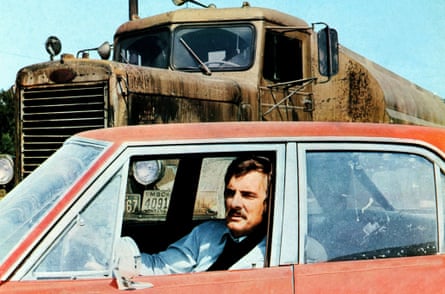
Dennis Weaver in Spielberg’s TV movie Duel, in which a monster truck plays predator. Photograph: Allstar/UNIVERSAL TV/Sportsphoto Ltd./Allstar

Nowadays, Martha’s Vineyard attracts a steady stream of tourists eager to visit the locations where Jaws was filmed. “It really is like walking around a movie set,” says Jones. “Before Jaws, there was a certain notoriety from the Ted Kennedy Chappaquiddick scandal, but the movie really eclipsed that. When we were making the documentary, we went with Lee Fierro [the Martha’s Vineyard resident who plays Mrs Kintner in the movie] to the stretch of coast where the beach scenes for Jaws were filmed. It’s very exciting to see those vistas that have become so iconic. And we got taken out to the wreck of the Orca [Quint’s boat], which was just a shell sticking out of the edge of the water. It was bizarre; we stood in it and touched it – it was like touching a piece of the true cross.”

The Jaws shoot was originally scheduled for 55 days, but the production swiftly turned into a logistical nightmare when the mechanical shark (three full-size, pneumatically animated models were constructed) consistently failed to play ball. Nicknamed Bruce after Spielberg’s lawyer, Bruce Ramer, the shark had been built by Bob Mattey, who had created the giant squid for 20,000 Leagues Under the Sea. The models worked fine in the warehouse, but the minute they were dumped into seawater, they started to malfunction. Day after day went by without any usable footage being shot, storms and seasickness the film-makers’ only reward.

Recalling the ordeal of the shoot, Spielberg told me: “Jaws to me was a near-death experience – and a ‘career death’ experience! I went to a party on Martha’s Vineyard and a very well-known actress came over to me and said, ‘I just came back from LA and everybody says this picture is a complete stinker. It’s a total failure and nobody will ever hire you again because you’re profligate in your spending and you’re irresponsible. Everybody’s calling you irresponsible!’ I had never heard the scuttle before, I didn’t ever hear the noise that was coming from Hollywood about me. So I was halfway through shooting the picture and this person tells me that my movie’s a disaster, and I am a disaster, and it’s over. And I really believed for the second half of the film that this was the last time I was ever going to shoot a film on 35mm.”

The lengthy shoot took its toll on the cast too. In particular, tensions emerged between Dreyfuss and Shaw to match those between their respective characters, ichthyologist Matt Hooper and crusty shark-hunter Quint. Partly modelled on local character Craig Kingsbury (who has a small role in the movie as the ill-fated Ben Gardner), Quint is a hard-drinking troublemaker who takes pleasure in taunting his city boy colleagues. It was a role into which Shaw threw himself with scene-stealing gusto, to the alarm of Dreyfuss. “There was a kind of sparring that went on between us,” Dreyfuss told the BBC in 1997. “It was both playful and – on my part – desperate. [Shaw] knew how to dish it out so you had to learn how to dish it back. He could be very vicious and his humour could be very cutting.” And, like his character, Shaw enjoyed a drink.

 The filming of the famous dolly zoom shot (pioneered in Hitchcock’s Vertigo) on the beach. Photograph: MPTVA/HA/LFI

But while Shaw proved a somewhat volatile presence, his work on screen was note-perfect, which was more than could be said for the shark. By the time the film-makers had enough usable footage in the can, the production was more than 100 days over schedule, with the budget spiralling toward the $9m mark, $3m of which had been blown on what Spielberg derisively called “the special defects department”. Yet Bruce’s failure to function proved the making of the film. Unable to get the shark action shots he wanted, Spielberg was forced to take a more Hitchcockian approach, working with editor Verna Fields to conjure tense sequences in which what we don’t see is more important that what we do. Meanwhile, composer John Williams filled in the gaps where the shark should be with an ominous score that has become as synonymous with screen terror as Bernard Herrmann’s themes from Psycho. The result was pure magic, causing Spielberg to concede that “had the shark been working, perhaps the film would have made half the money and been half as scary”.

It wasn’t until Jaws was test-screened at the Medallion theatre, Dallas, in March 1975 that the film-makers got the sense that they were on to a hit. “That was the first time I realised that the shark worked, the movie worked, everything about it worked,” Spielberg told me. “The audience came out of their seats. Popcorn was flying in front of the screen twice during the movie. And then I got greedy and thought, gee, could I make the popcorn fly out of their boxes three times? And that’s when I shot that scene in my editor Verna’s pool. I had this idea that maybe when Richard [Dreyfuss] goes underwater to dig the tooth out [of the sunken boat], what if Ben Gardner’s entire head comes out of the hole? And so I shot it in her pool with a prosthetic head and a plywood boat.”

The scene of Ben Gardner’s mutilated head floating into view did indeed prove a showstopper. It was just one of a number of intense, gory sequences that earned Jaws the reputation of being the most shocking movie ever to be awarded a family-friendly PG rating in the US. Writing in the Los Angeles Times, critic Charles Champlin complained that “the PG rating is grievously wrong and misleading… Jaws is too gruesome for children and likely to turn the stomach of the impressionable at any age.” (The Motion Picture Association of America defended its lenient rating by pointing out that “nobody ever got mugged by a shark”.)

All of which brings us back to the thorny question of what Jaws is really about. For years, I have insisted that Jaws is a classic monster movie “morality tale” in which the watery fate of potential victims is sealed by their on-land behaviour. Stephen King memorably wrote: “Within the frame of most horror tales we find a moral code so strong it would make a Puritan smile”, and that certainly seems to apply to Jaws. Key to this reading is the character of Hooper, who [plot spoilers ahead!] dies in the novel after having a sordid fling with Brody’s wife, Ellen, but miraculously survives on screen, largely because the affair doesn’t happen in the film. Benchley, who makes a cameo appearance in the movie as a news reporter, remembers that the very first thing Zanuck told him when writing the script was to lose “that love story, the whole sex nonsense”. Spielberg agreed, confirming to me that “my first impulse was to get rid of the melodrama and the soap opera aspects of the novel, the whole love affair with the ichthyologist and the police chief’s wife”. Instead, he wanted to “go right for that third act”, cutting to the chase with dramatic results. But once the affair had been removed, so too was the subtextual justification for Hooper’s violent death.
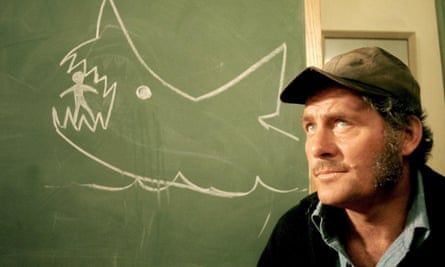
Robert Shaw as Quint, the fisherman who agrees to hunt down the shark, in Jaws. Photograph: Everett/REX_Shutterstock

Although the official explanation for Hooper surviving the shark-cage attack was the unplanned wrecking of the empty cage by a real-life predator (and stuntman Carl Rizzo’s understandable reluctance to get back in the water), it seemed clear to me that without the infidelity subplot Hooper became a heroic character who had to live. When I interviewed Spielberg in 2006, he reluctantly conceded that there was some logic in this. But by the time I spoke to him again in 2012, for BBC Radio 5 Live, he wasn’t buying it.

“The shark doesn’t care whether you’re married or single,” he laughed. “It just wants to eat ya!” But what about Hooper’s survival? I insisted. Surely that only makes sense because you cut out the affair? “Well, I cut the soap opera because I wanted to go out and do a sea-hunt movie,” Spielberg demurred. “I wasn’t interested in doing Peyton Place.”

So, Jaws isn’t a film about infidelity? (Or masculinity? Or Watergate? Or whatever?)

“No,” replied Spielberg definitively. “It’s a film about a shark.”

How JAWS Made a Template for the Modern Blockbuster

Peacock/Universal Pictures, via Associated Press


Much more than a mere creature feature, “Jaws” created a playbook that filmmakers have followed closely for 50 years.


By Rumsey Taylor and Eve Washington

The reporters cataloged more than 50 films, which include scores of deaths by sharks, dinosaurs, piranhas, anacondas, spiders, "Graboids," tornadoes, aliens and more sharks.June 18, 2025

Fifty years ago, Steven Spielberg’s “Jaws” terrified moviegoers. Its shocks still reverberate.

Its blueprint is now so recognizable that you have probably seen “Jaws” — even if you haven’t actually seen “Jaws.”

Here’s a breakdown of the plot (spoilers abound):

A mysterious creature


… stalks …

a remote island


… and attacks …

a nameless victim.


Next …

a reluctant hero


… challenges …

the town mayor


… and enlists …

a couple of experts.


Finally …

a major sacrifice


… leads to …

the final confrontation


… and …

the creature’s death
(it’s blown up).

Those nine points are what make “Jaws” “Jaws.” Put together the right way, they maximize suspense and spectacle without losing the human stakes.

“Jaws” didn’t invent the creature feature. By 1975, there had been 15 Godzilla movies and four King Kongs, as well as dozens of Hammer and Universal horror films, including “Creature from the Black Lagoon” in 1954. And Mr. Spielberg’s film included techniques popularized by other filmmakers, including Alfred Hitchcock and the famed B-movie producer Roger Corman.

Even if other films put similar elements into practice, none were as phenomenally successful as “Jaws,” boosted by a large budget and given a wide release on June 20, 1975.

The  creature stalks the remote location and attacks the first victim . Next, the reluc­tant hero challenges the local authority and enlists the experts . Finally, the sacrifice leads to the con­frontation and the crea­ture’s death .

Jaws1975
A great white shark stalks an
island and attacks a skinny­dipper . Next, a
policeman challenges the
mayor and enlists a scientist and hunter . Finally, the hunter’s death leads to a boat
attack and the shark’s death .

Alien1979
An
alien stalks a
spaceship and attacks an
officer . Next, the warrant officer challenges the
computer and enlists the science officer . Finally, the captain’s death leads to a
fight and the alien’s death .

Nope2022
A
U.F.O. stalks a rural
area and attacks a ranch
owner . Next, the rancher’s children challenges an impresario and enlists two
experts . Finally, one expert’s death leads to a
trap and the U.F.O.’s death .


These elements worked so well that dozens of films since then have more or less followed its playbook, to varying degrees of success.

To capture how widely “Jaws” has influenced Hollywood, we watched over 50 films that include most or all of those nine points.

Some are direct knock-offs, like “Great White” (1982), which was pulled from theaters after the distributor of “Jaws” claimed copyright infringement.

Others used the “Jaws” structure in new genres. “Alien” (1979) is said to have been pitched as “‘Jaws’ in space.”

This template can even be seen in films as recent as “Nope,” from 2022.


Wednesday, May 28, 2025

The Three Musketeers and The Four Musketeers

The two-part Dumas adaptation, being released by the Criterion Collection in a 4K restoration, features a superb cast—including Michael York, Raquel Welch and Charlton Heston—and the director’s classic wit.

By
David Mermelstein

Few works have sparked the cinematic imagination as routinely as Alexandre Dumas’s 1844 novel “The Three Musketeers.” A hasty count indicates some 40 movie versions (the first and latest from France, in 1903 and 2023) and many more made just for television. But by common consent, the best yet is Richard Lester’s “The Three Musketeers” (1973) and “The Four Musketeers” (1974), originally conceived as a single film with intermission but ultimately released as two separate pictures. Both have now been fetchingly restored in 4K and this week debut on home video in that form as part of the Criterion Collection. (Enthusiasts may select a two-disc Blu-ray set or a four-disc 4K UHD/Blu-ray combo pack.)

The Philadelphia-born Mr. Lester worked primarily in the U.K. and remains best known today for “A Hard Day’s Night” and “Help,” his mid-1960s filmed collaborations with the Beatles. At an early stage, there was apparently some thought of casting the Beatles as Dumas’s sword-fighting trio plus their protégé D’Artagnan—an idea quickly quashed.

Instead, thanks in large part to the independent European-based producers known collectively as the Salkinds (specifically Ilya and his father, Alexander), a host of Hollywood and British stalwarts not only assumed the leads but also most of the supporting roles. Three seasoned actors in their prime—Oliver Reed, Richard Chamberlain and Frank Finlay—were cast as the world-weary musketeers: Athos, Aramis and Porthos. Michael York, fresh from his central role in the soon-to-be Oscar-winning “Cabaret,” nabbed the plum part of the callow D’Artagnan (ultimately, the fourth musketeer), who spends nearly as much time bedding beautiful women as engaging in derring-do.
Michael York and Raquel Welch PHOTO: CRITERION COLLECTION

Yet these iterations of 17th-century masculinity were in many ways outshone by their colleagues in character roles. The Salkinds already had a professional relationship with Raquel Welch, the very essence of feminine sexuality at the time, so her participation—as Constance, the queen’s dressmaker and the object of D’Artagnan’s ceaseless affections—was non-negotiable. Who knew then that this screen goddess, often as not wooden in dramatic parts, had talent as a comedic foil? Mr. Lester brought this gift to the fore by having her underplay the yuks.

Landing Faye Dunaway after “Bonnie and Clyde” but before “Chinatown” and “Network” was a coup, and she portrays the ruthless Milady de Winter, an agent of much misery, with such unforgettable hauteur that it’s hard to imagine anyone else inhabiting the role. Christopher Lee lends her lover, the fearsome one-eyed Comte de Rochefort, exactly the kind of menace that made him irreplaceable on screen for so many decades.
Faye Dunaway PHOTO: CRITERION COLLECTION

Mr. Lester opted for subtlety in selecting the royal couple. Dubbed into English by Richard Briers, the prolific French actor Jean-Pierre Cassel proves convincingly wry and appealingly oblivious as Louis XIII. And Geraldine Chaplin brings an appropriately cool mien to Queen Anne, who cares little how her actions affect others, let alone the nation.

But the real casting masterstroke was placing Charlton Heston, one of Hollywood’s leading leading men, in the pivotal role of Cardinal Richelieu, the power behind the throne and the figure discreetly controlling most of the saga’s action. Heston plays Richelieu with a welcome light touch, giving just the right weight to sotto-voce comments, asserting authority by never raising his voice and letting an arched eyebrow or a sidelong glance serve his character’s needs. The actor was initially courted to play one of the musketeers, but both Heston and Mr. Lester soon came to appreciate that veering from the obvious was the smarter move.
Charlton Heston PHOTO: CRITERION COLLECTION

In other ways, too, these films depart from the predictable without ever sacrificing what’s elemental. So, yes, there’s plenty of acrobatic swordplay in these pictures—much of it seemingly influenced by the martial-arts movies then all the rage in Hong Kong—as well as gorgeous, period-accurate costumes, all but Welch’s courtesy of Yvonne Blake, to say nothing of Brian Eatwell’s splendid production design. (The films were shot entirely in Spain, though tells are few.) But to all this Mr. Lester has added his trademark antic charm and off-kilter wit. No one familiar with his earlier pictures will fail to spot those qualities here: the offscreen ambient noises and cross-talk; the use of multiple cameras for a single scene; and the strange objects that routinely appear, including a working organ in the middle of a garden and a carousel powered by peasants. And who can forget that royal chess match in which live dogs substitute for rooks, knights, pawns and the like?

Let’s have a word, too, for the screenwriter, the Scottish author George MacDonald Fraser, whose early “Flashman” novels, with their outlandish bounder protagonist, served almost as dry runs for his spirited condensing of Dumas’s massive chronicle into two efficient pictures, each running less than two hours. It was Fraser who, when Mr. Lester asked how a particular scene should look, said, “like a Breughel painted by Rembrandt”—a comment the director clearly took to heart.

None of this makes these pictures high art, but they are consummate entertainment. Few of us want a meal of Bergman and Bresson every night. Sometimes, the menu calls for romance, intrigue, broad comedy, gaudy settings, lavish dress, and, of course, sexy women and dashing men. And when you want to dine out on that, Mr. Lester is happy to serve you.

Monday, May 26, 2025

E.T.


On May 26, 1982, Steven Spielberg unveiled E.T., The Extra-Terrestrial at the Cannes film festival. The sci-fi classic would become a summer smash en route to four Oscar wins at the 55th Academy Awards. The Hollywood Reporter’s original review is below:

Jaws. Close Encounters of the Third Kind. Raiders of the Lost Ark. And now, E.T., The Extra-Terrestrial. Steven Spielberg has done it again. He has created another instant American classic.

As director and co-producer (with Kathleen Kennedy), Spielberg has crafted with warmth and humor a simple fantasy that works so superbly on so many levels that it will surely attract masses of moviegoers from all demographics. At the heart of the story line, E.T. is really My Favorite Martian, with a bizarre-looking but disarmingly lovable alien (designed by Carlo Rambaldi, who designed the creature in Close Encounters).

However, the film goes past the myth of a marooned spaceman trying to figure out a way back home. While E.T. is being befriended, hidden and protected (from the adults) by his Earth buddies, the picture conveys a relationship story, an adventure, a mystery, and ultimately, the time-worn but always timely message that no matter how different God’s creatures may be, there’s a common bond between the thinking ones — because they’re also capable of love. Sometimes, kids are always the ones to recognize this on a more immediate level than adults.

Sound sappy? Yes. But Spielberg’s magic as a director is to take these themes and weave them into a straight-forward tale so delicately that you are never sledge-hammered and come to perceive screenwriter Melissa Mathison’s intent through the exquisite subtlety of this beguiling fairy tale.

Amid the wonder, excitement and joy that virtually every frame of this picture elicits — swept along by John Williams’ playful and uplifting score — one really does fall in love with the delightful little alien, and indeed, finds oneself reaching for the handkerchief (and realizing but not minding upon later reflection) right on cue. Never mind that certain plot leaps of faith are necessary to advance this fantasy along, the characters (mostly kids) are so compelling and endearing that you’re easily pulled in.